


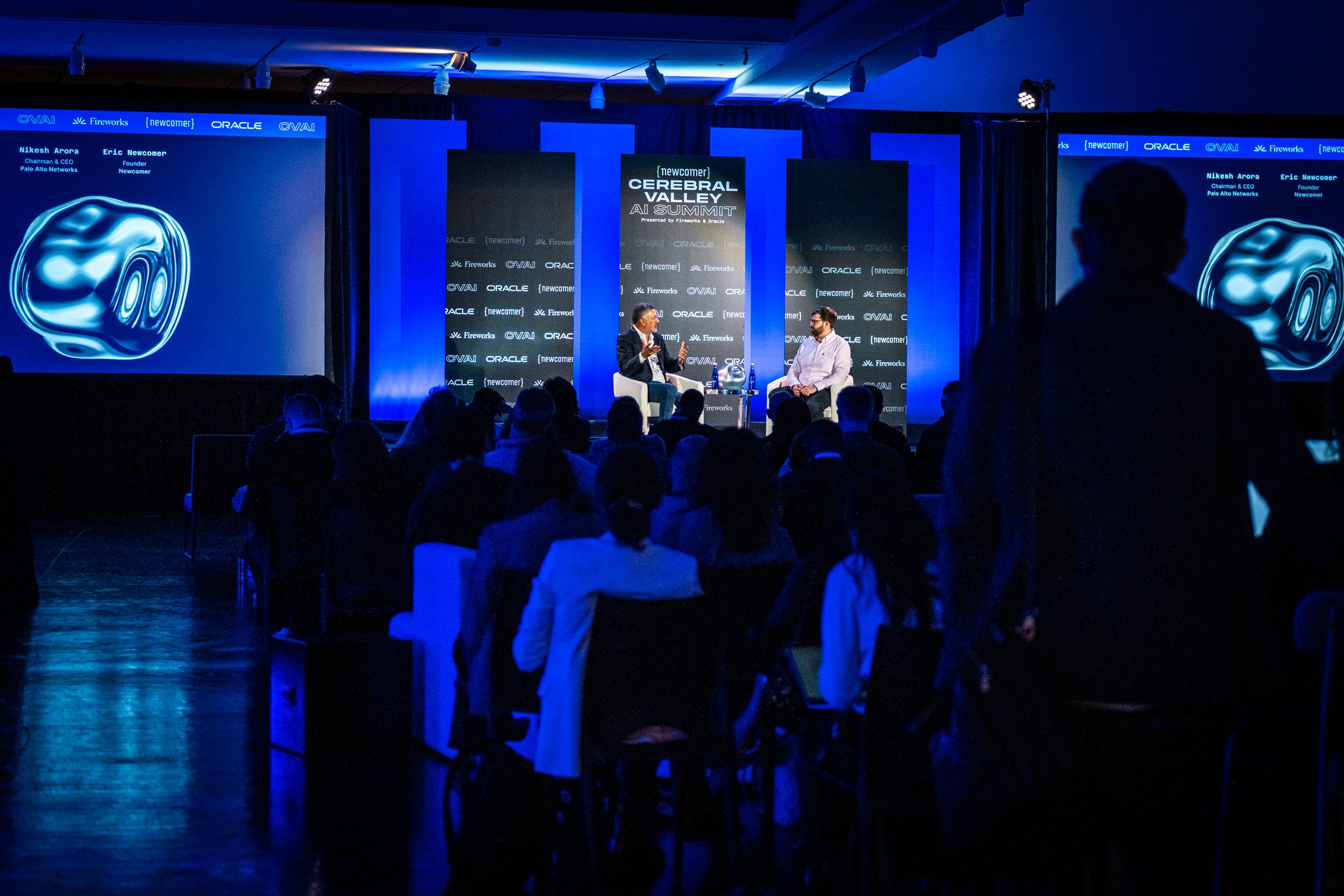
We’ve digested the key insights from the Cerebral Valley AI Summit last week, pulling together observations from a host of industry leaders including Ali Ghodsi, Nikesh Arora, and Hemant Taneja.
Contemplating the year ahead, founders and investors were laser-focused on what’s emerged as a key leverage point in the frantic AI buildout: the cost of compute. We heard from CEOs with various approaches to bringing down costs, ranging from purpose-built chips and application-specific inference to open-weight models and aggressive real-time price arbitrage based on how much intelligence is needed for certain tasks.
There were fierce debates on some of these questions: open-weight models are a huge source of contention. The danger of the big labs gaining an intelligence monopoly was on the minds of many founders, though others viewed that issue as much ado about nothing.
There were also points of consensus: few doubt the scale of the AI opportunity, public pushback and bubble dynamics notwithstanding. In our spot poll at CVAI, 80% of respondents thought the AI industry was in a bubble, likely to deflate next year or later, but there was also near-unanimous optimism about the upcoming IPO of Anthropic.
There was also plenty of talk about Nvidia.
You can see our initial takeaways from the Cerebral Valley AI Summit here. Read on for photos and further details on all the conversations and highlights from speakers including Arora of Palo Alto Networks, Ghodsi of Databricks, Taneja of General Catalyst, and many, many more.
The Cerebral Valley AI Summit wouldn’t be possible without our sponsors.
We were thrilled to count Fireworks as a presenting sponsor, as they’ve consistently supported our summits over the years. Their specialized AI platform has built them into one of the top inference providers.
Oracle, our other presenting sponsor, was among the first to sponsor and support the inaugural Cerebral Valley AI Summit in early 2023. It’s become one of the largest AI cloud providers, handling many of the industry’s most important compute deals.
IREN, a core sponsor, provides purpose-built AI infrastructure that runs on renewable energy and powers many of the world’s biggest AI products.
We have many other great sponsors at the forefront of AI, and we couldn’t do the summit without them: Index Ventures, Exa, Nebius, WorkOS, ElevenLabs, Higgsfield, Felicis, SambaNova, Bessemer Venture Partners, Weekend, Liquid AI, QuantumBlack, Sapphire Ventures, Outshift by Cisco, and OnePay.
This post is too long for email, so click here to read the full post and see slides on the AI 100 from Bessemer Venture Partners and the results from our live audience survey during the Cerebral Valley Show.
AI’s Public Perception Problem (Hemant Taneja)
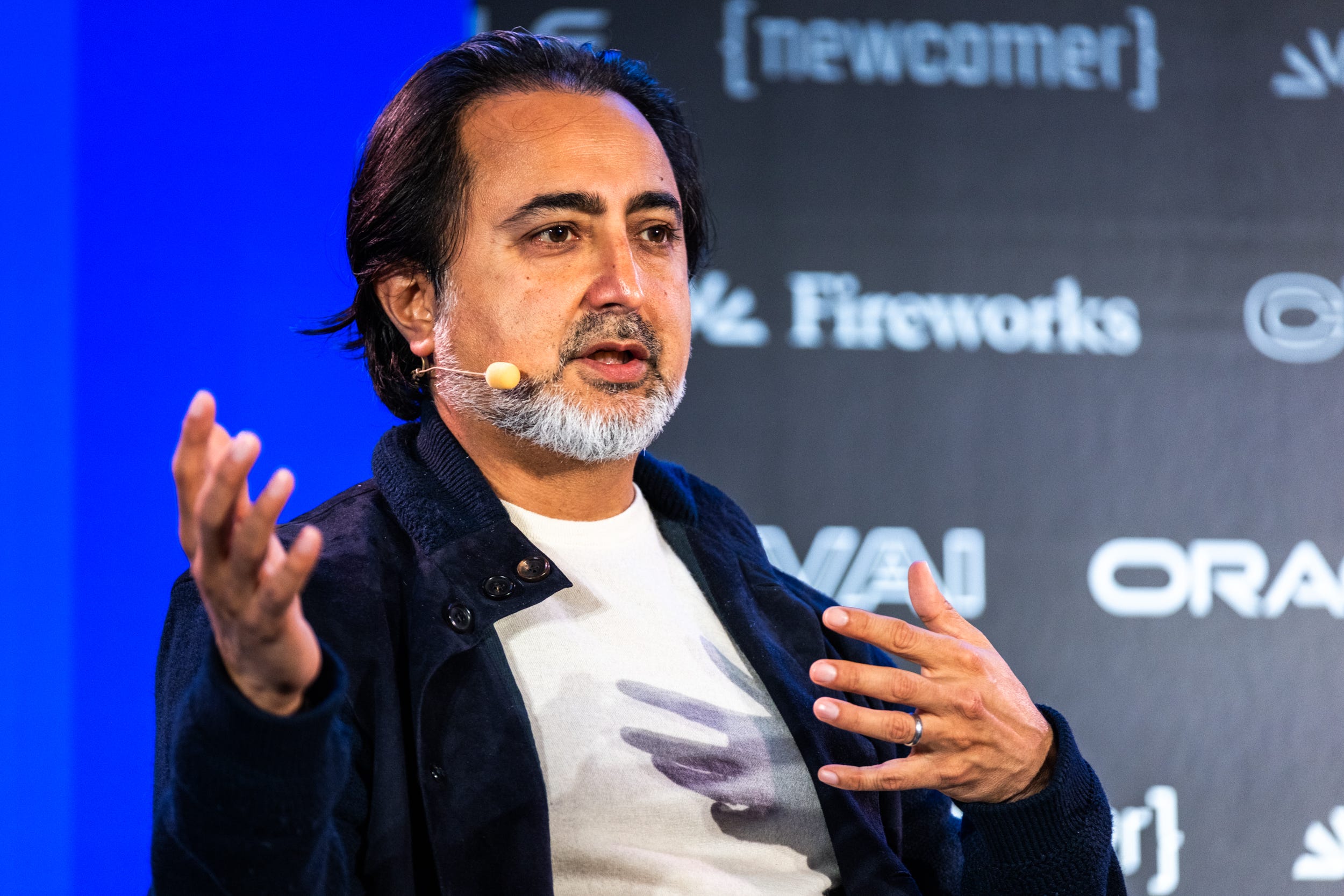
It was fitting given all the geopolitical news that our opening speaker at CVAI was General Catalyst CEO Hemant Taneja, who has charted the megafirm on a course that’s given him a broader view than most of the societal dynamics of the moment. On stage, he said the AI industry needs to do much more to change the way it’s viewed.
“Capitalism is a privilege,” he noted, one the industry could lose if it didn’t pay more attention. “What the world is seeing is this concentration of value in a handful of companies — it’s not about Silicon Valley versus the rest of the world. This is about a handful of companies versus everyone.”
Leaders should talk less about future job losses and more about “abundance,” such as more accessible healthcare and education, and “agency” for people to use technology to build wealth for themselves, Taneja said.
The scale of the shift means that venture capital itself will need to change: with incumbents so large that a $1 billion company may no longer be an interesting acquisition target on its own, the real advantage can come from taking that technology and integrating it more directly into the broader service economy. It’s a strategy General Catalyst has already leaned into, with the embrace of AI roll-ups and the purchase of a hospital under his leadership.
As for Jensen Huang’s departure from Nvidia, it leaves a “huge concern” about continuity in AI industry leadership, Taneja said. But a weakened Nvidia could be an opportunity for more chip startups to flourish. Founders should become more flexible about their compute stack, he said, to avoid over-dependence on a single chip provider.
Chip Competition Abruptly Heats Up (Robert Wachen)
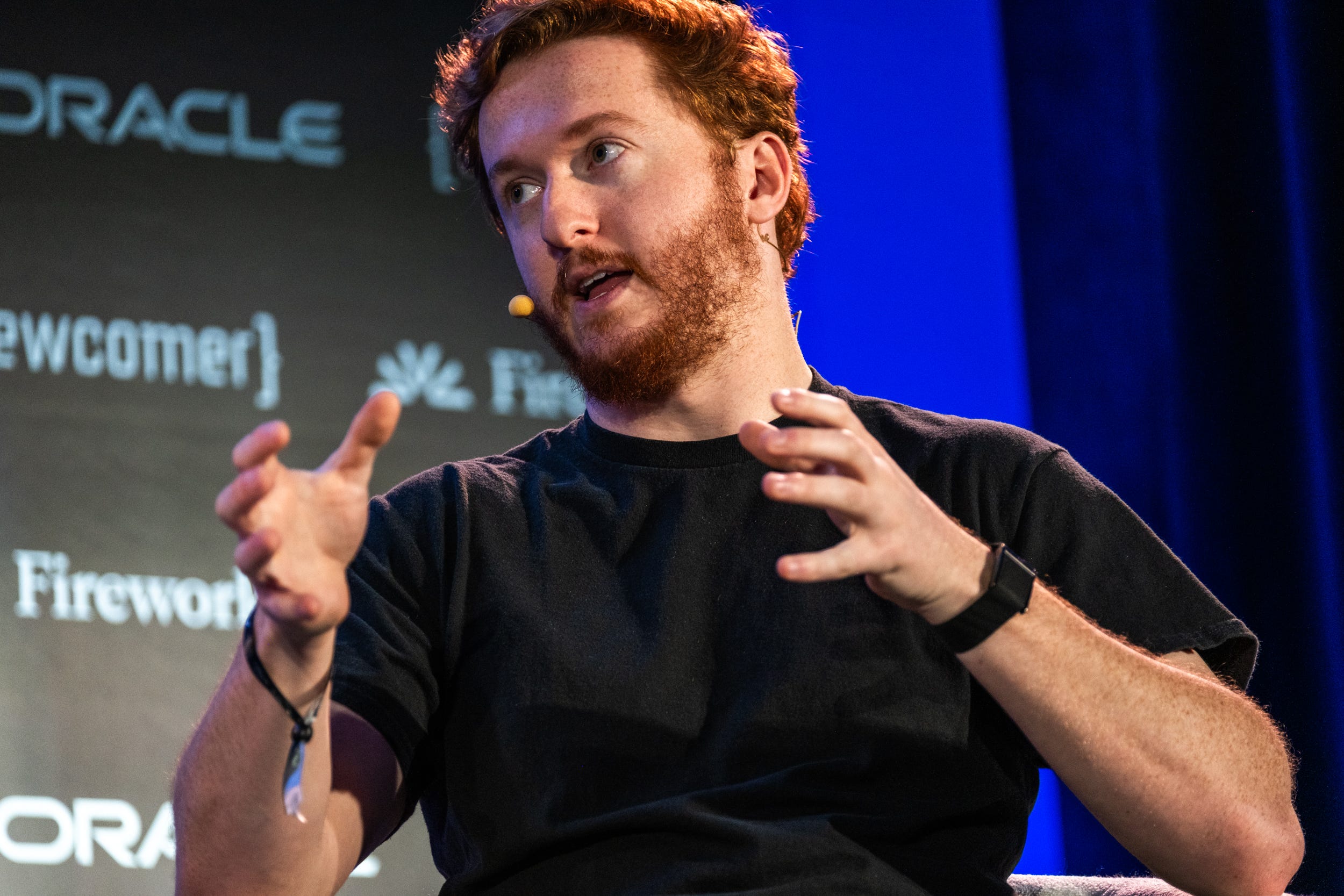
Taneja’s comment about chip competition is music to the ears of Robert Wachen at Etched, an AI chip-to-rack startup where more than 100 former Nvidia employees work. Wachen said that cohort, “like myself, always had this perfect view of Jensen. It’s sad to see the reality not match that.” Certainly, though, a more competitive chip market is good for Etched.
“We’re still in the biggest compute shortage we’ll ever be in,” Wachen noted. He was very bullish on agents, which are already driving much of the work at Etched. “We have more agents than people in the company working on every problem 24/7.” He predicted that the value of chip design would decline as agents took over, but physical-world problems like vertically integrating chips and interconnects into data center racks would remain difficult to solve.
Enterprises Want Choice and Cost Efficiency (Ali Ghodsi)
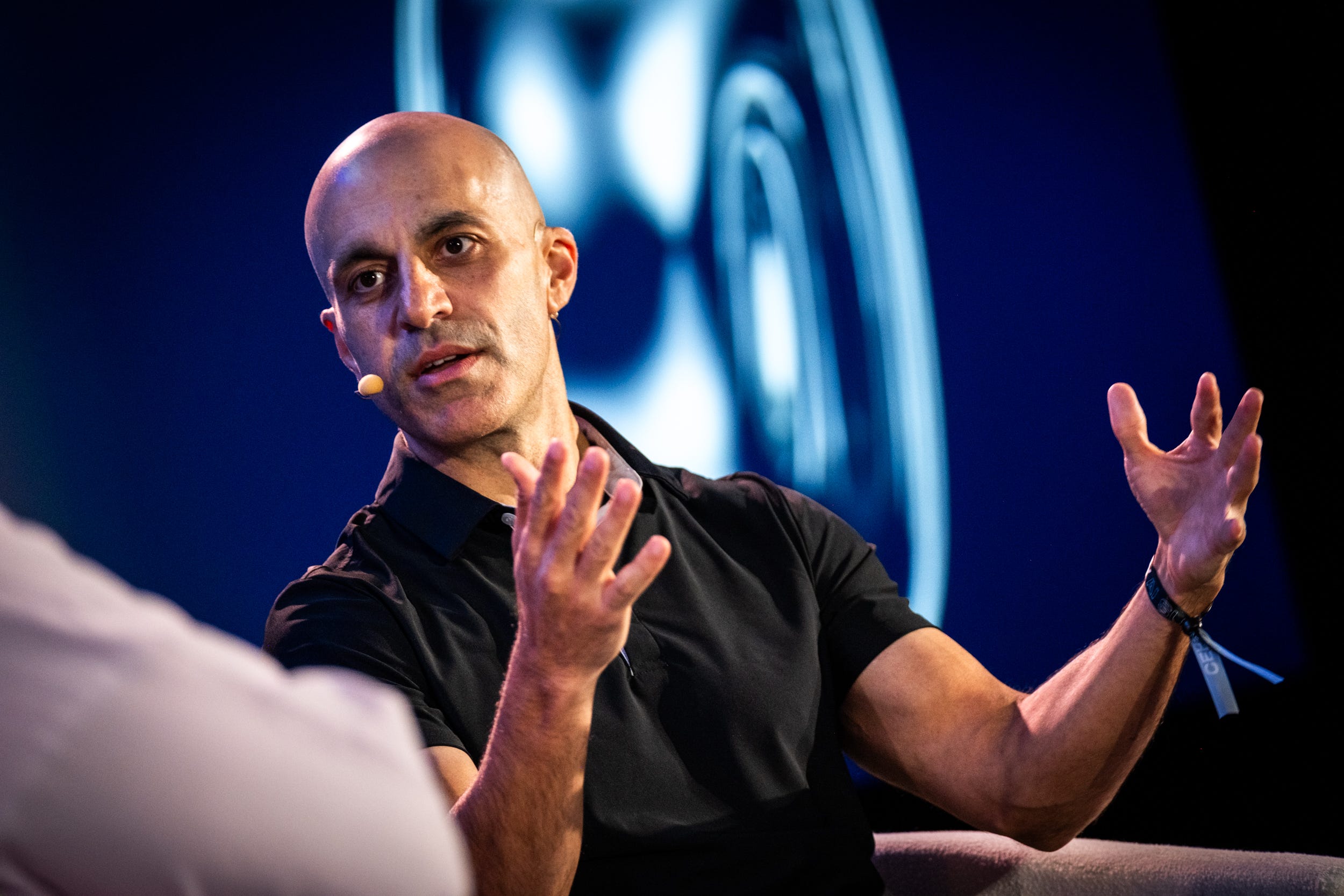
Databricks CEO Ali Ghodsi was the most direct about the possible negative consequences of Huang’s exit from Nvidia, which had served as a financial backstop across the AI ecosystem. “Whenever there was hesitation and things on the bubble, he was there to say, don’t worry about it, I got their back,” Ghodsi said. “That’s no longer there. So I think on the margin, it’s going to start hurting a lot of players.”
The near-term damage is limited, he said, because the chips pipeline is three years out. “We’re buying chips today that they were working on a few years ago.” Databricks, which sits on top of the hyperscalers, is mostly insulated.
Ghodsi also stood by his call that 2026 is a bad year to go public, but he doesn’t believe in staying private forever and Databricks will list eventually.
Businesses are increasingly prioritizing cost-cutting measures to make the economics of AI work, Ghodsi said, a theme that would be echoed throughout the day. Databricks routes more than four quadrillion tokens across OpenAI, Anthropic, Gemini, and open-source models, and its new smart router sends simpler queries to cheaper models. In his view, models aren’t sticky; the harnesses developers work in, like Claude Code and Codex, are.
Ghodsi also says he now runs Databricks through Genie, the company’s agent product, which maps the org chart, reads email and Slack, and drafts his messages for him to review and send. “I’m like 10x better CEO now than a year ago,” he said.
A New World of Cybersecurity Risk (Nikesh Arora)
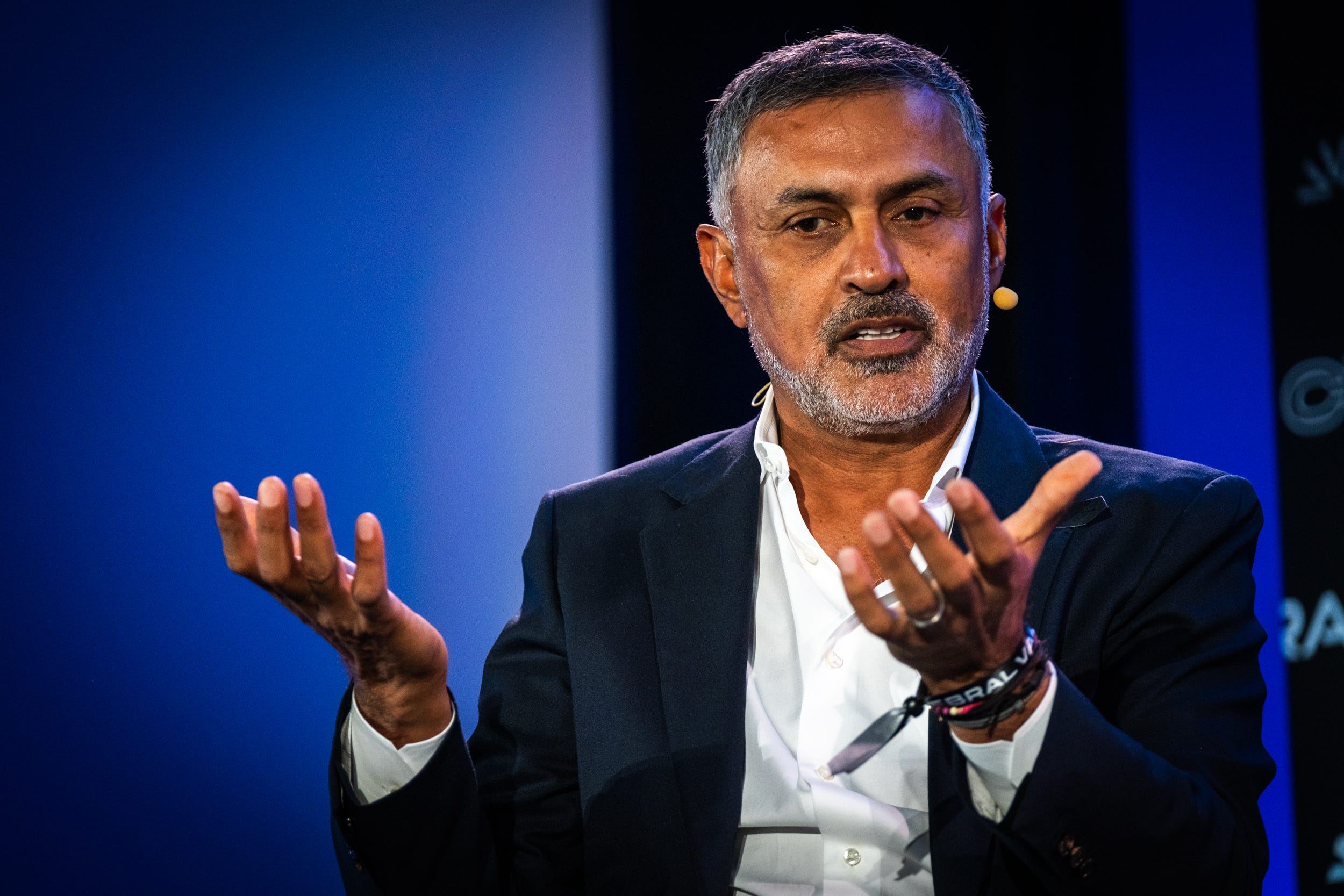
Palo Alto Networks CEO Nikesh Arora also believes in a multiplicity of AI models when it comes to stemming the mounting cybersecurity threat posed by AI agents. Attack times have already shortened to 18 minutes, Arora said, since agents can overwhelm some security systems. But no single provider has the model to rule them all: each cutting-edge model from OpenAI, Anthropic, or Google can successfully find about 30% of vulnerabilities, while open-source models can make up the final 10%, according to Arora.
The best way to stem attacks will be to train smart cyber systems on a specific industry’s typical data flow, and then repeat the process “one at a time” with each enterprise customer to get networks up to snuff.
Although Shaun Maguire and other tech leaders were floating his name as a potential Nvidia CEO, Arora deflected on the question. He said Huang’s departure would likely lead to short-term instability but would hardly be a death knell for the firm.
The Opportunities in Hardware (Qasar Younis)
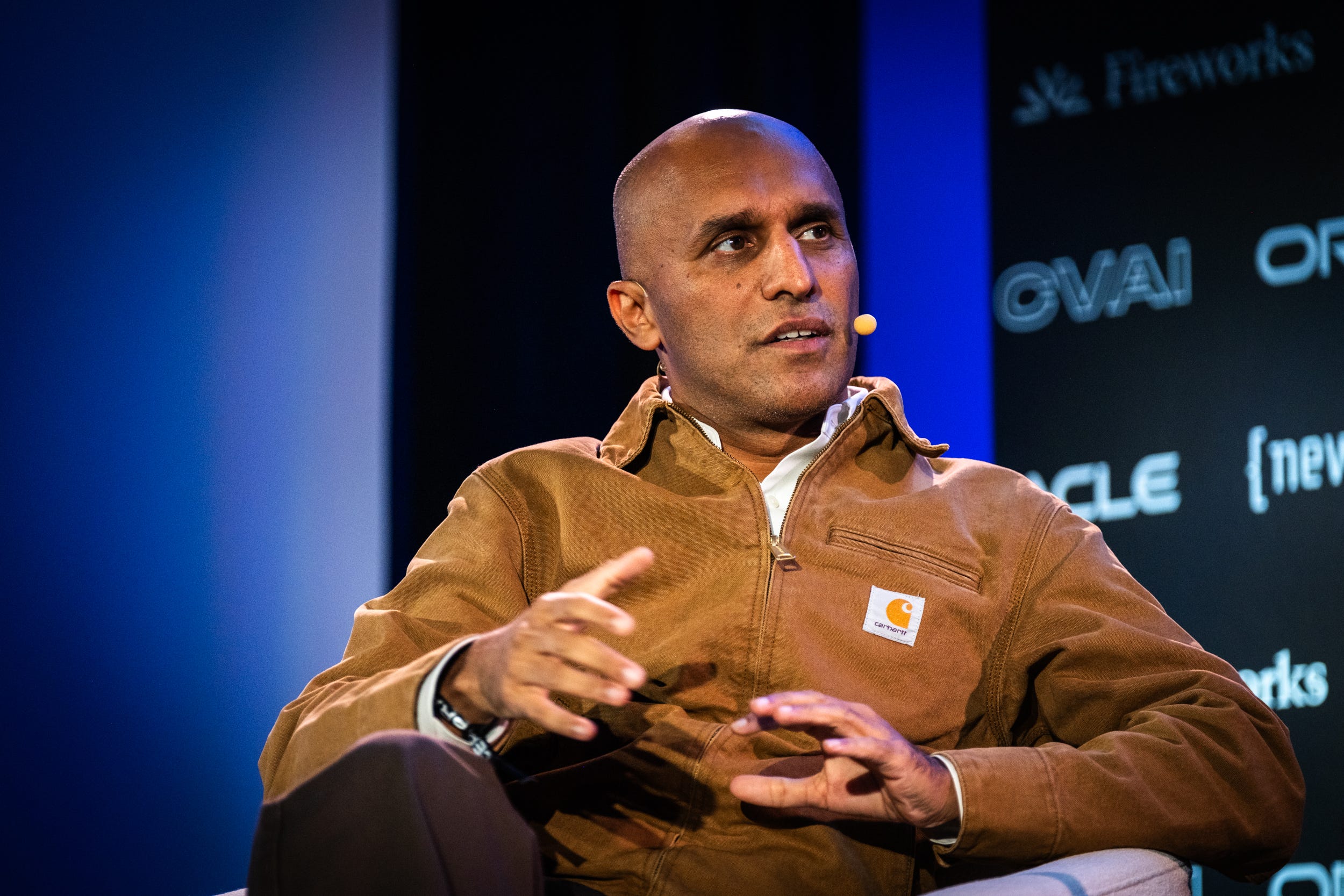
Qasar Younis, founder and CEO of physical AI software firm Applied Intuition, challenged AI industry leaders to get outside the San Francisco echo chamber, comparing local VCs to synthetic data in an AI model: “they help, but they can also get, like, really weird outcomes.”
Younis, who was formerly the COO of Y Combinator and began his career with General Motors in Detroit, recalled a recent trip backpacking through Kyrgyzstan, where “nobody talks about AI, nobody gives a shit.” He attributed anti-AI sentiment in America to inequality and wage stagnation: “People are unhappy with the status quo, and I think they just want somebody to yell at.”
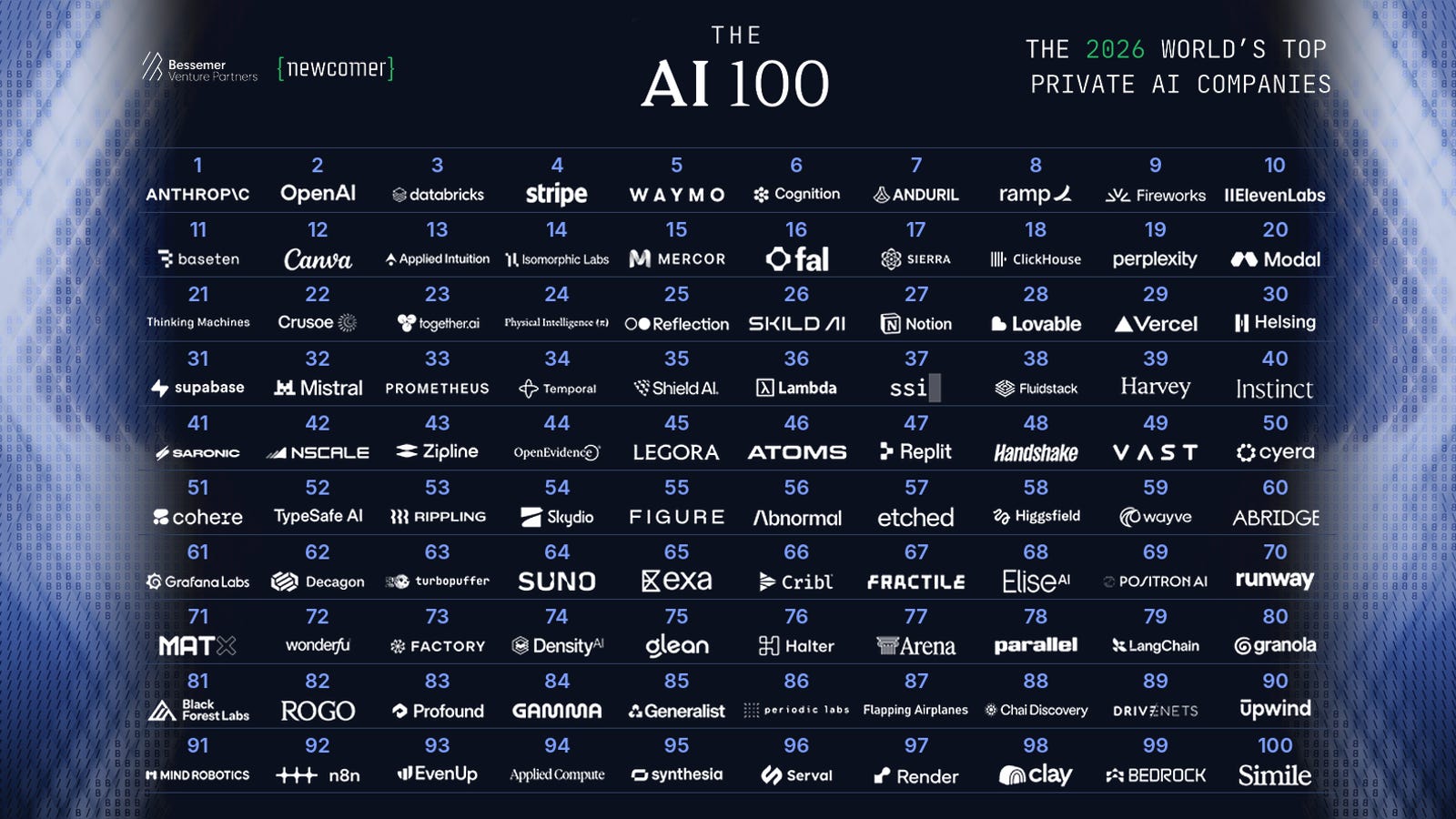
Applied Intuition, which came in 13th on Newcomer and Bessemer Venture Partners’ AI 100 list, sells “any tool that you would need to design, test, and deploy autonomous systems” to “anyone that makes a physical machine.” The surprise, Younis said, was where demand turned up: in areas like military drones rather than automobiles.
Younis also showed himself to be relatively bearish on the future of humanoid robots, saying that “the commercial model hasn’t been figured out yet” and concurred with Newcomer’s sentiment that “Scale is not all you need in robotics.”
Move to Where the Spending Is Strong (Aravind Srinivas)
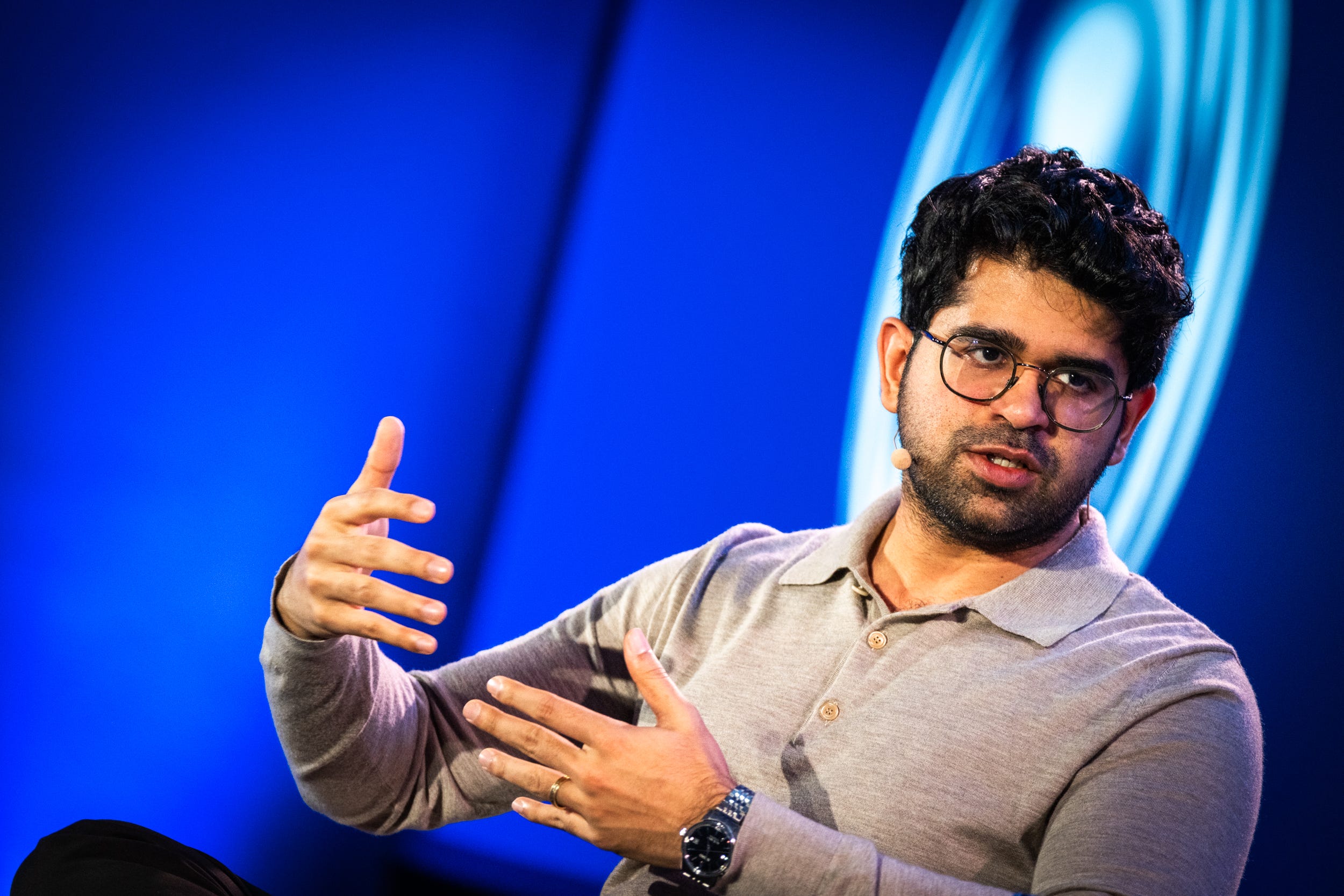
Perplexity CEO Aravind Srinivas enjoyed something of a victory lap onstage after his company was voted most popular “short” at last year’s CVAI. At the time, the company’s chatbot, whose research abilities rivaled ChatGPT’s and Claude’s early versions, seemed to be losing relevance.
Now he says its naysayers got it all wrong, and will again. “I would bet the same this year. If you guys short us, you’re gonna lose more money next year,” he said.
Perplexity now primarily serves enterprise customers, Srinivas said, a recognition of token costs and companies’ willingness and ability to pay for them. He rebuilt the company around a harness and infrastructure rather than a chatbot, separating it at a time when “a lot of companies are unable to adapt to new times,” he said.
Perplexity changed its strategy after Srinivas realized that AI leans on being recursive, or narrower and repetitive in the way it learns, rather than spreading via network effects. For most AI companies, “eighty percent of the revenue is probably coming from twenty percent of the users… It might even be ninety-ten.”
“There are only a few people who really know how to take the most out of these things and automate a lot of these things without being wasteful.”
Unlike most AI companies, Perplexity is also not using inference companies to lower its compute costs, instead post-training its own models and lowering server costs. Srinivas did not comment on the company’s numbers or financials but said it is “doing pretty well enough that we could IPO any time from now to 2028.”
Faster, Cheaper Models (Guillermo Rauch)
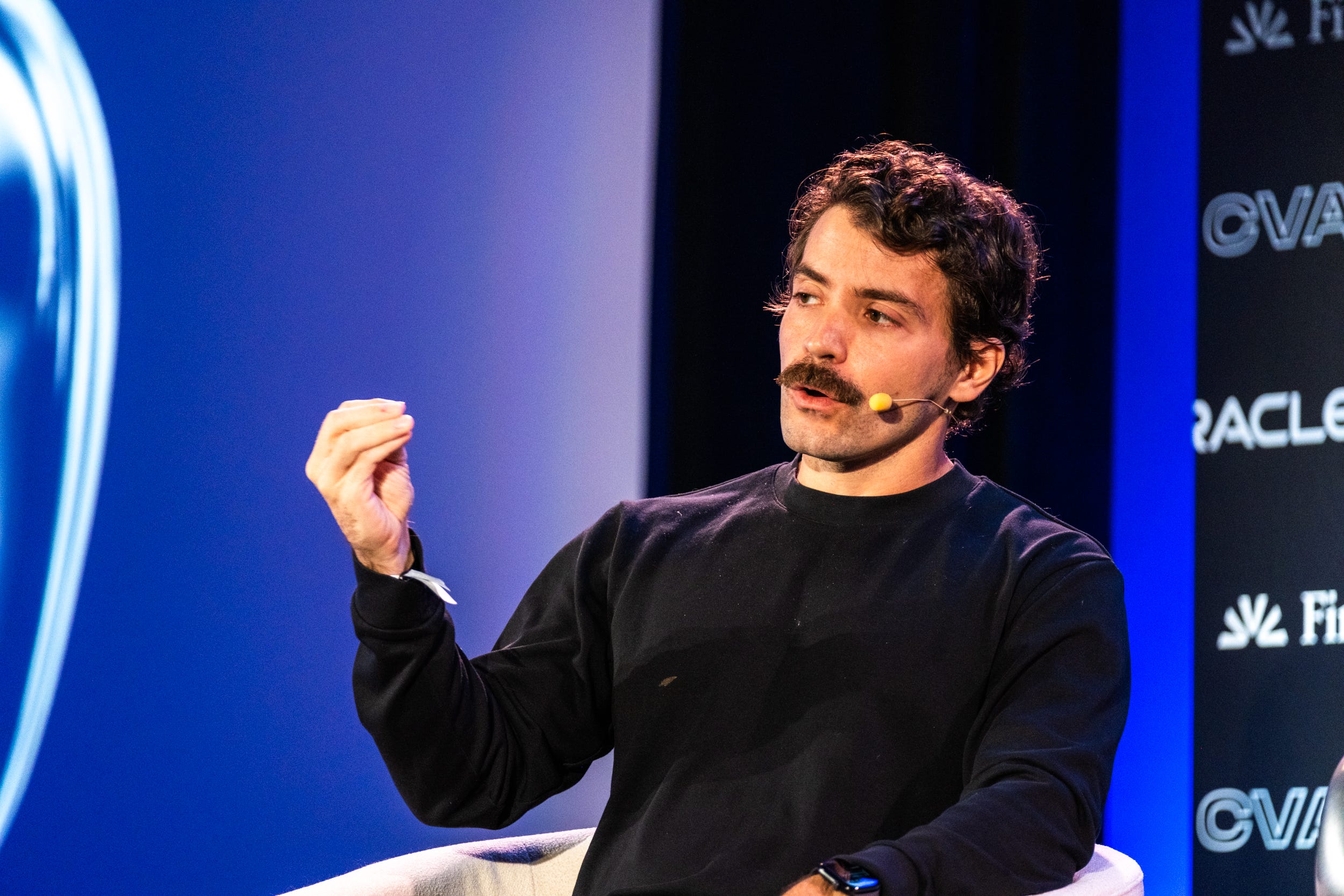
After the era of “token-maxxing” ran up many budgets, Vercel CEO Guillermo Rauch says companies are now choosing a mix of small, large, fine-tuned, and open-weight models to save on costs. He argued that spreading AI across many companies, rather than concentrating it in a few, is what’s best for the world and for America, since competition will lead to multiple winners.
Rauch talked up the rise of decision models around coding tasks, which emphasize speed and are cheaper than chat-based models. He said they were the most-requested models on Vercel’s AI Gateway.
To stay competitive, businesses won’t have the luxury of keeping proprietary data out of the hands of AI agents, he said. But identity protocols will have to be added on top, so agents will be able to work on behalf of users with secure permissions.
In the past two weeks, Rauch said, Vercel has talked with five CISOs whose companies were breached, with attackers using swarms of agents to move through their systems.
Agents as ‘Real’ Lawyers (Ryan Daniels)
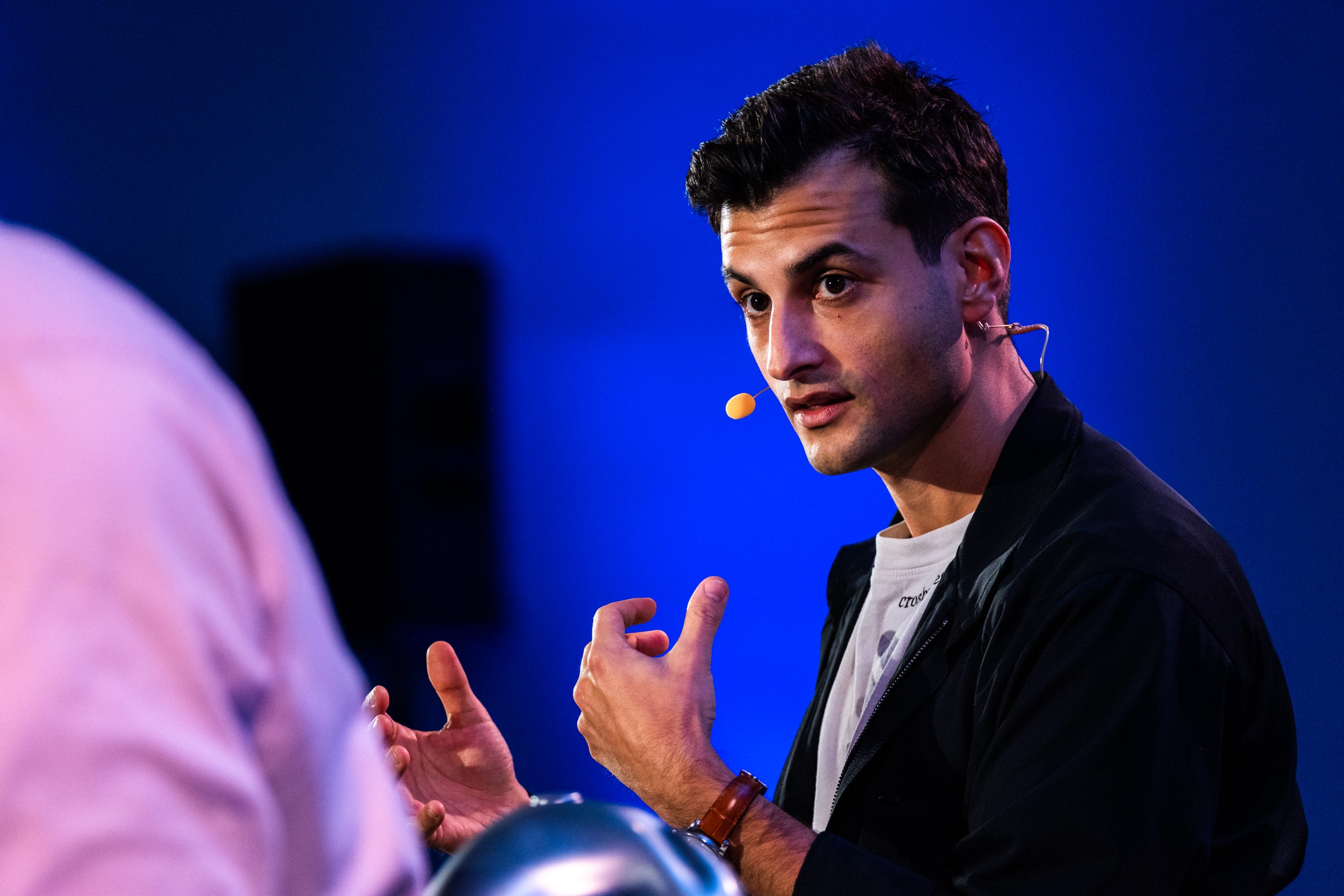
Ryan Daniels, founder of Crosby, offered an interesting take on what disruption can look like in one of the verticals viewed as most ripe for AI adoption.
“We have a law firm entity, and we have liability insurance and everything that a law firm has, and we have lawyers,” Daniels said, “but fundamentally, we are the first company that we know of that is selling legal AI to non-lawyers to interact with.” Crosby has raised $85 million from investors such as Lux Capital, Index Ventures, and Sequoia.
Daniels, himself a lawyer whose parents are law professors, says law firms — historically underpinned by human labor and knowledge, high hourly rates, and hard-to-automate services — have been ripe for AI disruption.
His intuition that legal services would be AI’s biggest market after coding has also been borne out with a host of other companies like Harvey, Legora, and Manifest playing in the same market. His startup is also at the forefront of figuring out what parts of work humans can and will still do, and how that changes the nature of work.
He considered buying law firms, but decided it’s only “incremental,” and instead focuses on getting “rid of the billable hour. We hire every lawyer by choosing the ones who genuinely want to offload their minds to agents.”
Even as he said agents can do everything on a computer screen that a human does, he was not worried about the labor or job disruption that it might seem to portend. He points to engineers getting more productive due to AI coding, where they have “felt the most empowering and, like, energizing experience ever.”
He does, however, say that working in such an environment, where AI eats into tasks only humans formerly could do, requires a different mindset for employees to thrive. “Every single person has to have a pliable mind and be comfortable with the fact that every three months, what they thought only they could do before, an agent can do or a computer could do.”
Building Outside the Big Labs (Asher Spector)
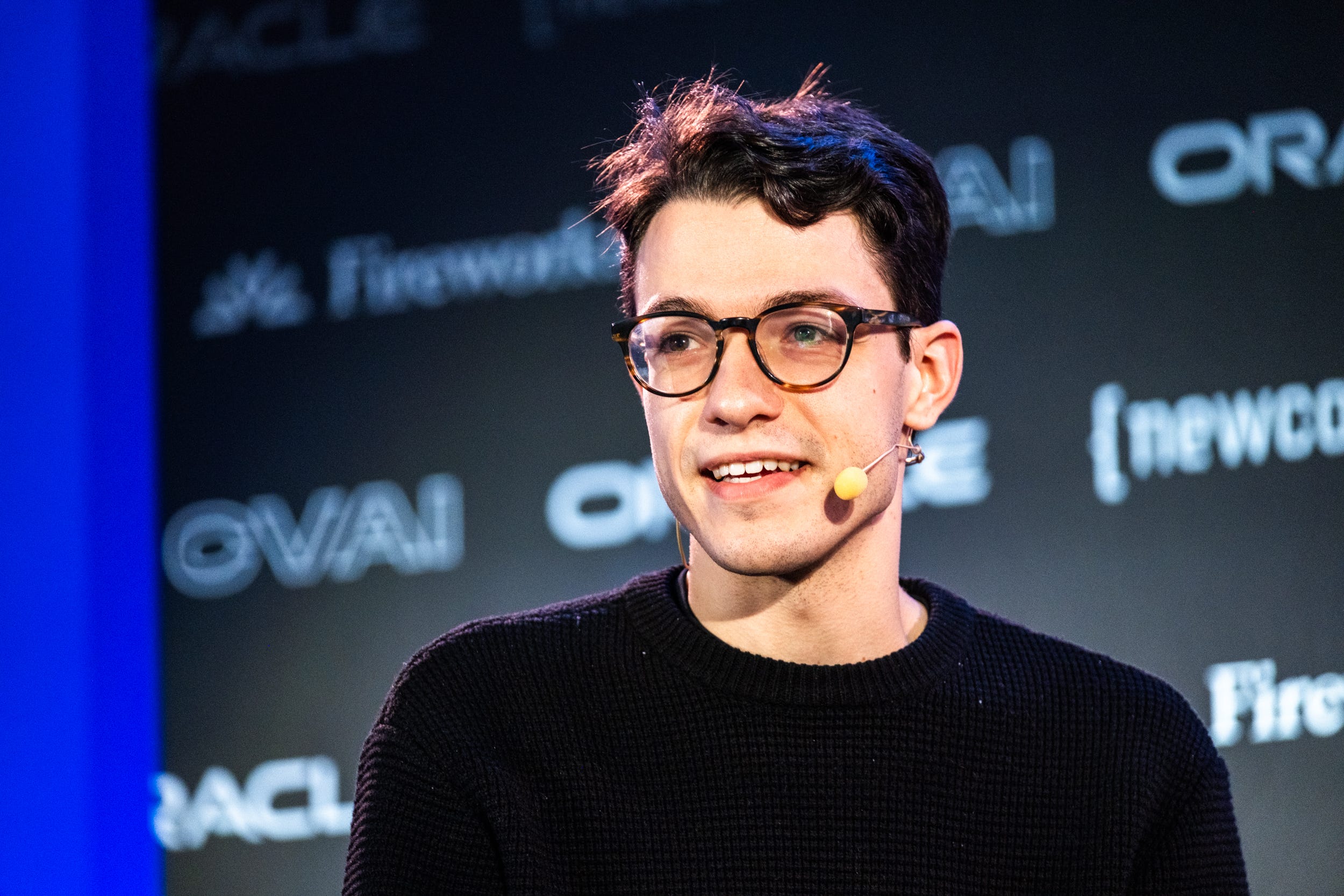
“I’m sure eventually other people will go after the same parts of the stack we’re going after,” Flapping Airplanes co-founder Asher Spector said in response to a question about OpenAI or Anthropic encroaching on their domain. “It’s not to try to be smarter than them or work harder than them. It’s also just to have different incentives. And I think the advantage we have is that we don’t have the innovator’s dilemma.”
Spector described Flapping Airplanes as “a research lab devoted to making AI efficient.” In some instances, that means creating a custom megakernel that runs on Nvidia GPUs. Nvidia is also an investor in the firm. When Spector was asked whether the two firms are competitors and how he felt in the wake of Jensen Huang’s resignation, he said only that they were excited to continue working with the hardware giant.
Spector was also guarded about the focus of Flapping Airplanes’ research across the stack, saying only that “we do a little bit of everything.” He did note that “the thing we’re actually the most focused on is training... one of the things that our framework does is it doesn’t just make chips more efficient, it actually makes them more expressive.”
Who’s Training the Models? (Brendan Foody)
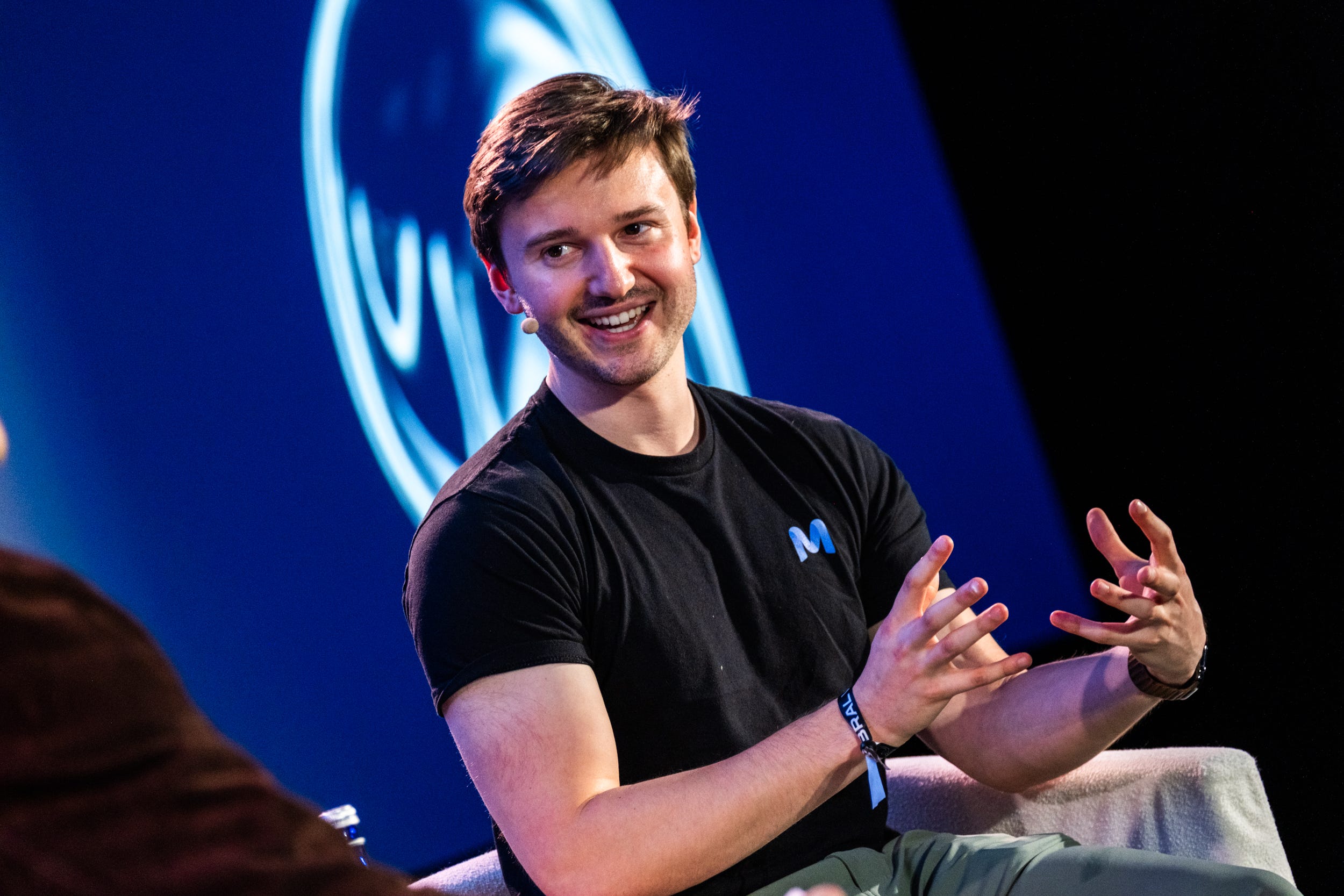
The shift to AI agents has changed who trains AI models. Labs once relied on armies of low- and medium-skilled workers writing clean sentences for early chatbots. Now, said Brendan Foody of Mercor, building agents takes top engineers, lawyers, doctors, and bankers to design evaluations and reinforcement learning environments.
Mercor, which started out automating the hiring process, rode that shift after it began working with OpenAI in 2024. It now has experts in every occupation the Labor Department tracks across more than 100 countries, and pays them over $7 million a day. That includes sommeliers teaching models to pair wine with dinner.
“The market for humans to help improve models is bound by the amount of things that a human can do that a model can’t do in any given domain,” Foody said.
Foody’s bet is that the frontier labs won’t capture all of that value. Mercor is now pitching enterprises on post-training their own models, which he said generally makes sense once a company spends more than $100 million a year on inference. Customers including Cursor, Cognition, Harvey, and Sierra have already made that math work, he said.
He granted that OpenAI and Anthropic will be enormous businesses. But, he said, “there can’t be a duopoly on intelligence. Everyone from the Fortune 500 to Nvidia to the US government is trying to ensure that value accrues to the rest of the economy.”
The Risks of Big-Lab Dominance (Igor Babuschkin)
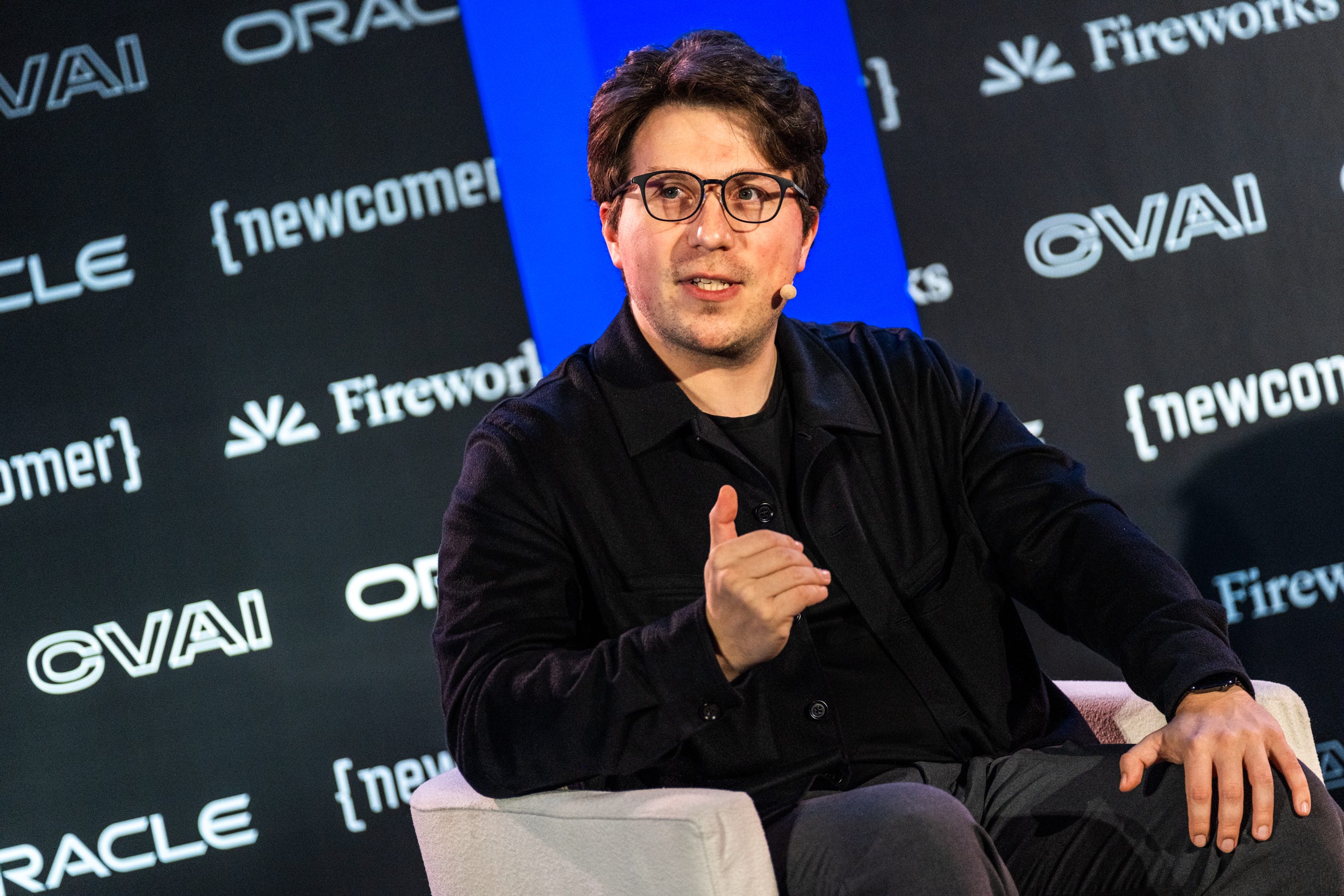
The concentration of AI in a handful of labs is a risk for every company and person who will depend on it, said xAI co-founder Igor Babuschkin. He’s betting his new company, River AI, can give businesses, and eventually individuals, models they own and improve themselves.
“I just simply cannot see a future where we’ll just have one giant AI company and we all have to ask for permission if we want to use intelligence,” he said. He framed it as an ideological battle where the big labs feel like it’s their responsibility to be the controllers and the owners of the AI systems.
River AI’s first product is software that lets companies post-train and serve models on their own hardware. Traditional enterprises mostly lack confidence, he said, but will come to see “there’s actually no magic behind it.” River AI has raised $1 billion from General Catalyst and AMP PBC, as well as Nvidia and AMD. Babuschkin joked that the 10-figure seed round was “table stakes” for AI these days.
He argued a distributed world is also safer: many moderately capable models are automating work like insurance claims and accounting, with no single company or person able to do outsized harm.
Jensen Huang’s resignation from Nvidia creates “a lot of uncertainty” for open-weight advocates, Babuschkin said, calling Huang the “leader of the pack” when it came to open-weight models. Still, he said the nature of deep learning is on the side of the people who are defending open-weight.
He also thinks progress is speeding up. Citing METR’s study of research acceleration inside Anthropic, he said that if the trend holds, “very likely by next year, we’ll have these super intelligent systems that are better than any human at any economically valuable task.”
Open-Weight Models on the Rise, Hackers Eye Compute (Matan Grinberg, Lin Qiao)
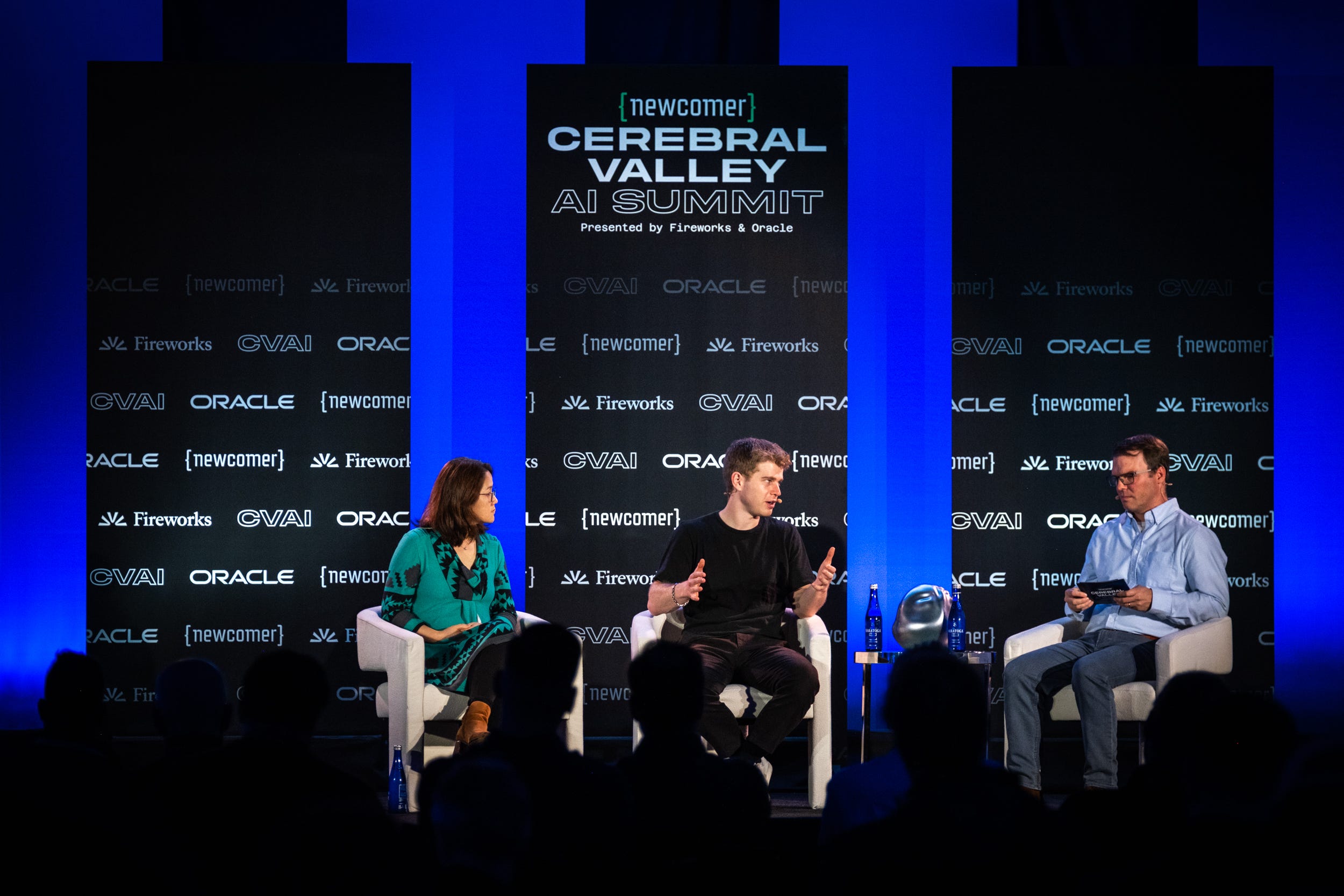
Open-weight models have gone from a rounding error to a major share of the work running at coding-agent startup Factory in less than a year, Matan Grinberg said in an onstage conversation with Fireworks’ Lin Qiao.
At the start of 2026, open models accounted for about a basis point of the tokens passing through Factory, which makes AI coding agents, Grinberg said. By March it was roughly ten basis points, by May a single-digit percentage, and it is now “way into double-digit percent.”
“In many of our customers, more than half of their tokens are to open models,” he said.
Grinberg, who counts Khosla and Sequoia as investors, credited better open models and routing for this growth. Factory’s agent, Droid, separates tasks that need frontier closed models from those that can go to cheaper, faster ones. “For so many of these tasks, it is not worth six dollars per million tokens to do it,” he said. Factory uses Fireworks to run those open models.
Qiao, whose company was valued at $17.5 billion in July, also addressed a major security incident that Fireworks, an inference provider, disclosed last week. She described it as “LLM jacking”: an organized attack, possibly by people with a crypto-jacking background, aimed at monetizing compute and tokens. “Apparently there is a black market for that,” she said. Fireworks worked with Palo Alto Networks on forensics and used CrowdStrike and Wiz sensors for detection, she said, adding that every company needs such tools “because you may not even know you’re being attacked.”
Looking to 2027, Qiao predicted “a lot of agents talking and working with each other,” which she said would shift engineers’ work from writing code to evaluating how agents reach their results. “If an agent burns $50 of tokens for a $1 job, it’s not that useful,” she said.
The AI 100 (Byron Deeter, Talia Goldberg)
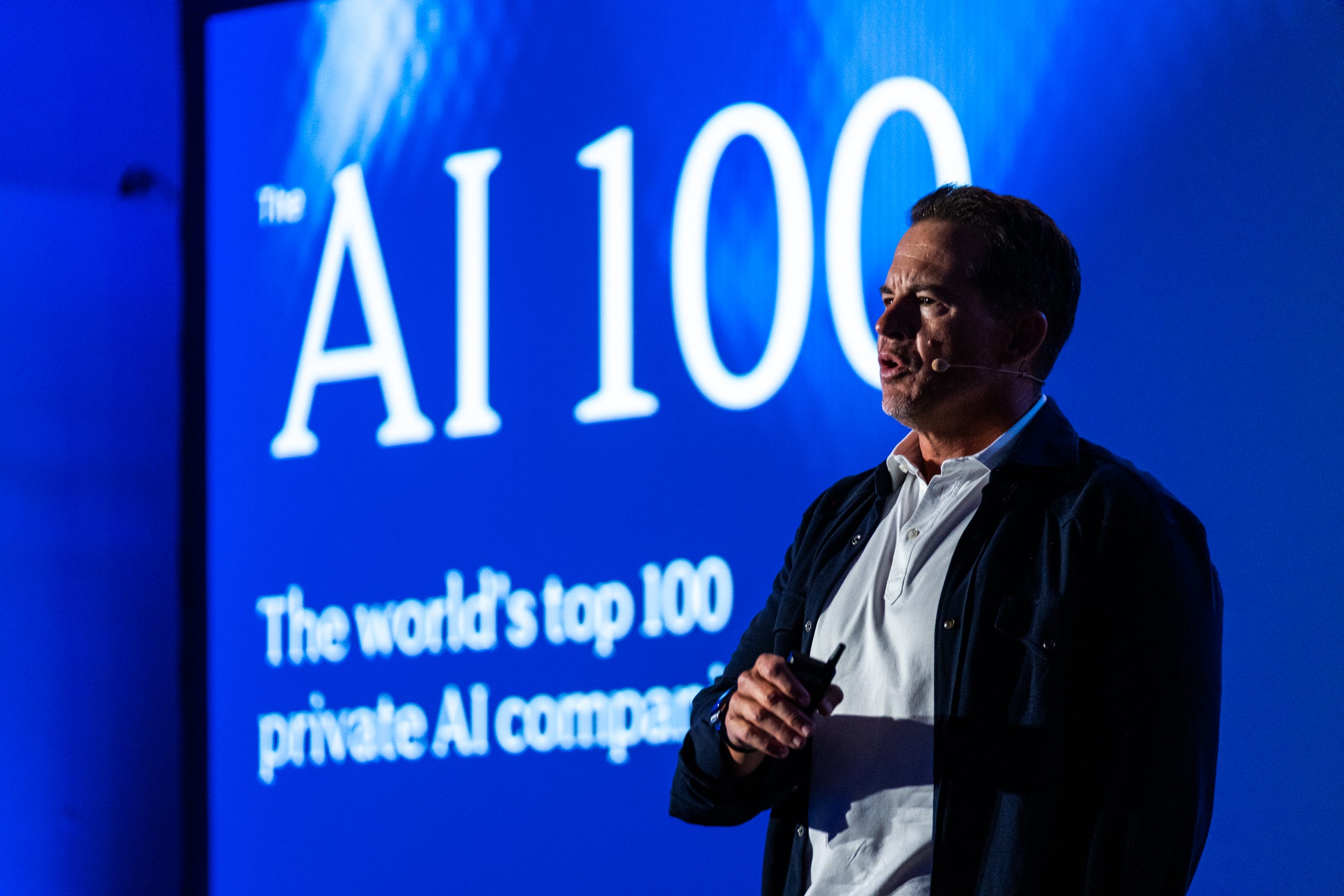
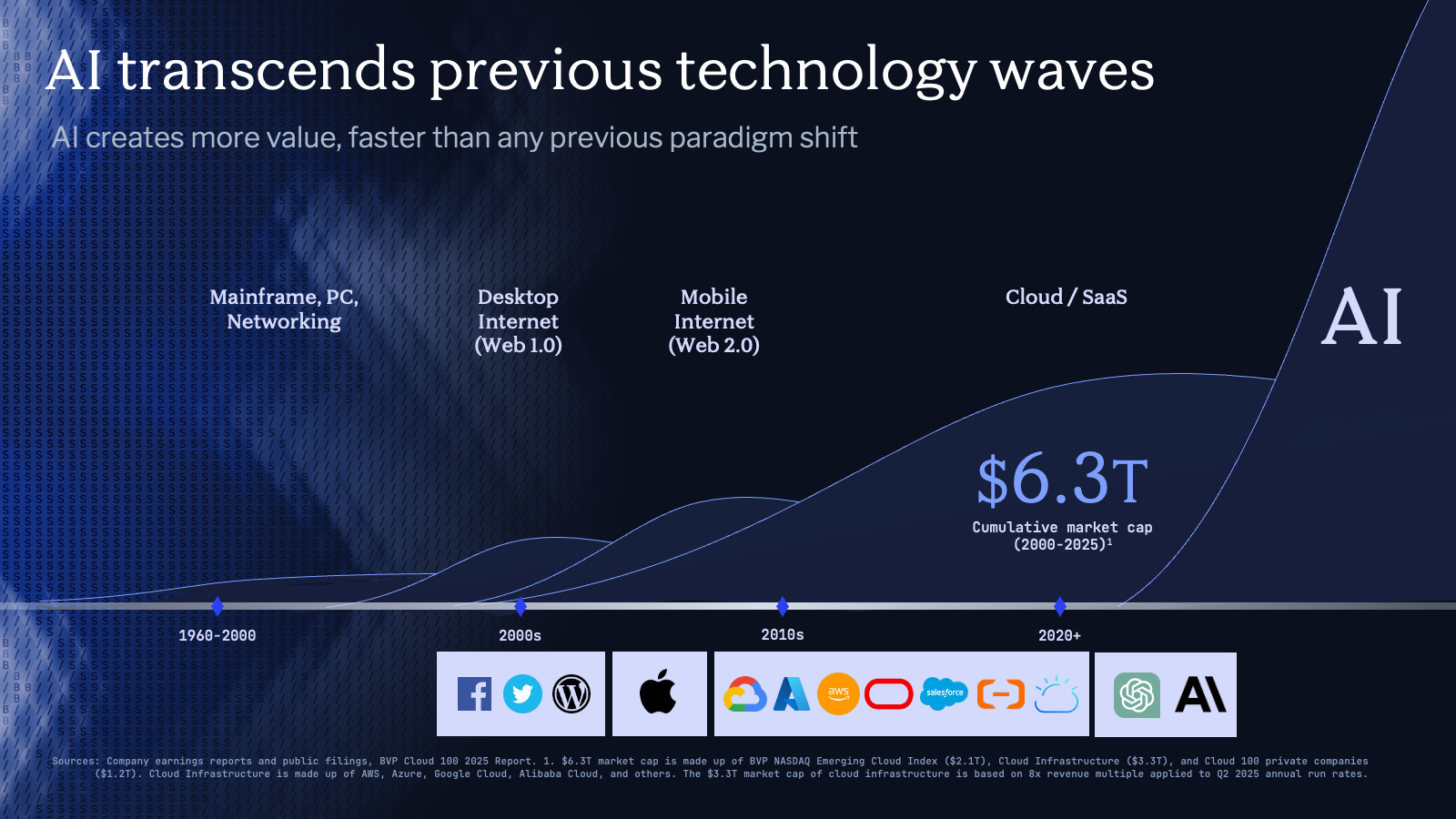
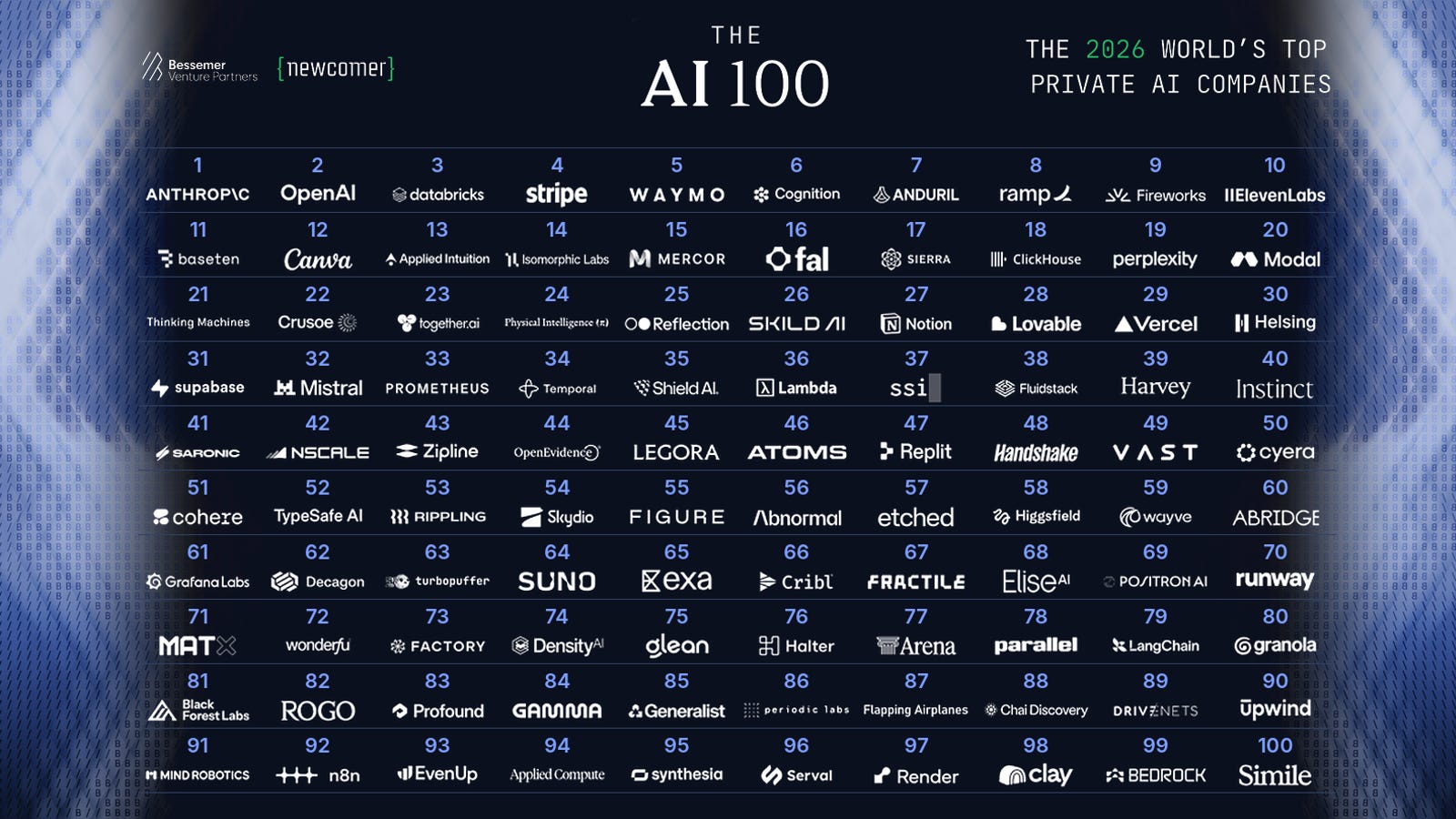
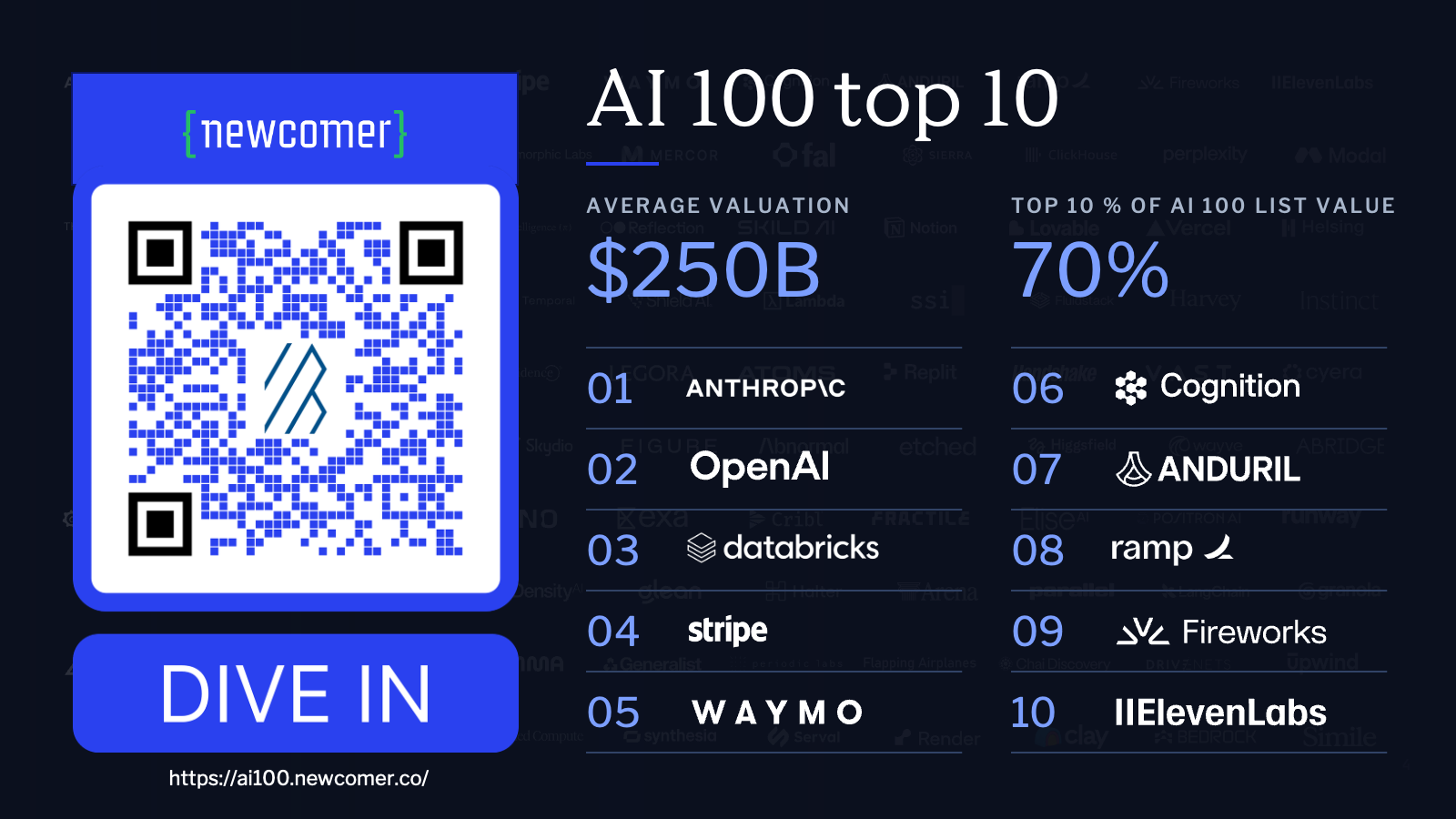
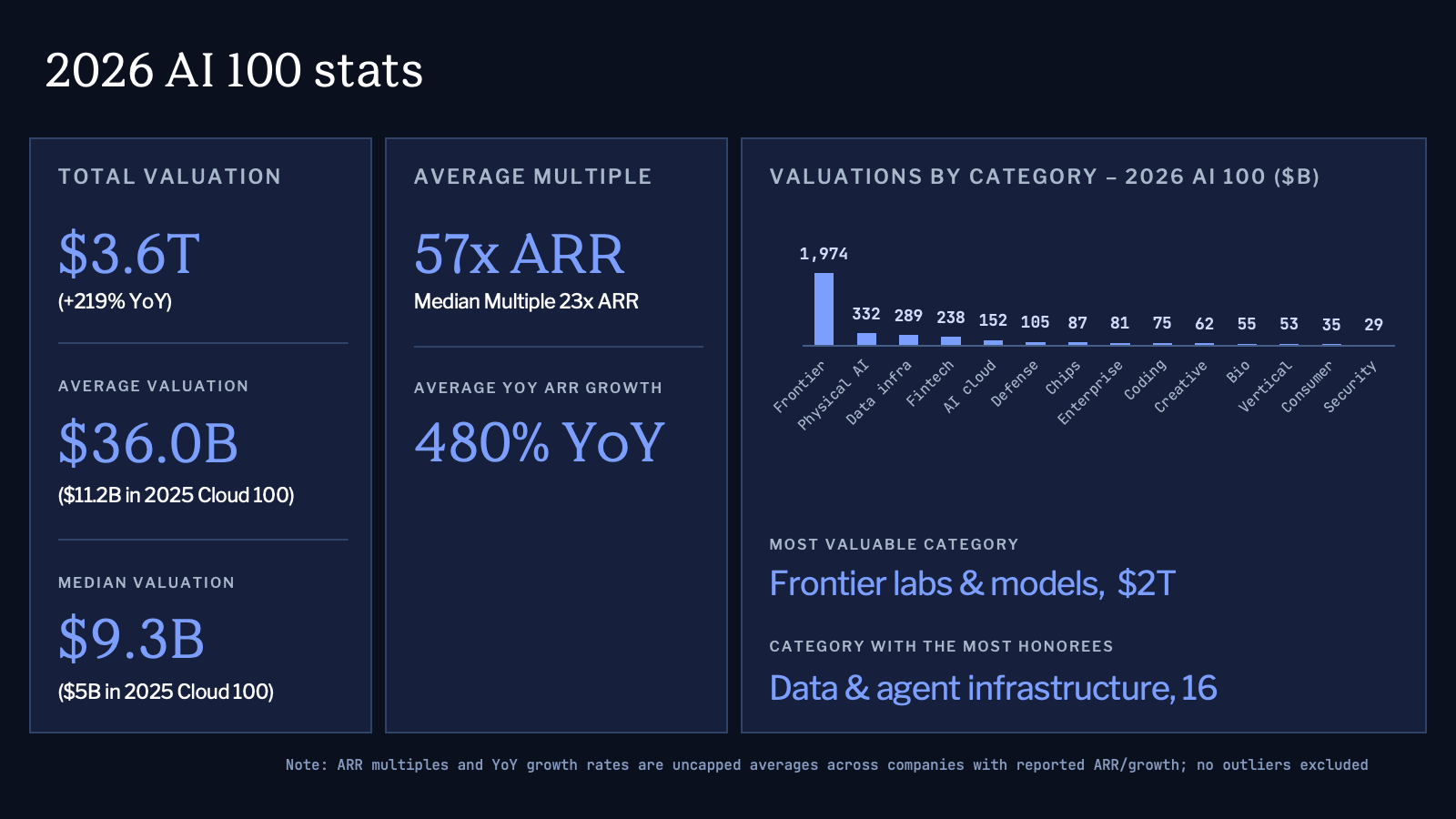
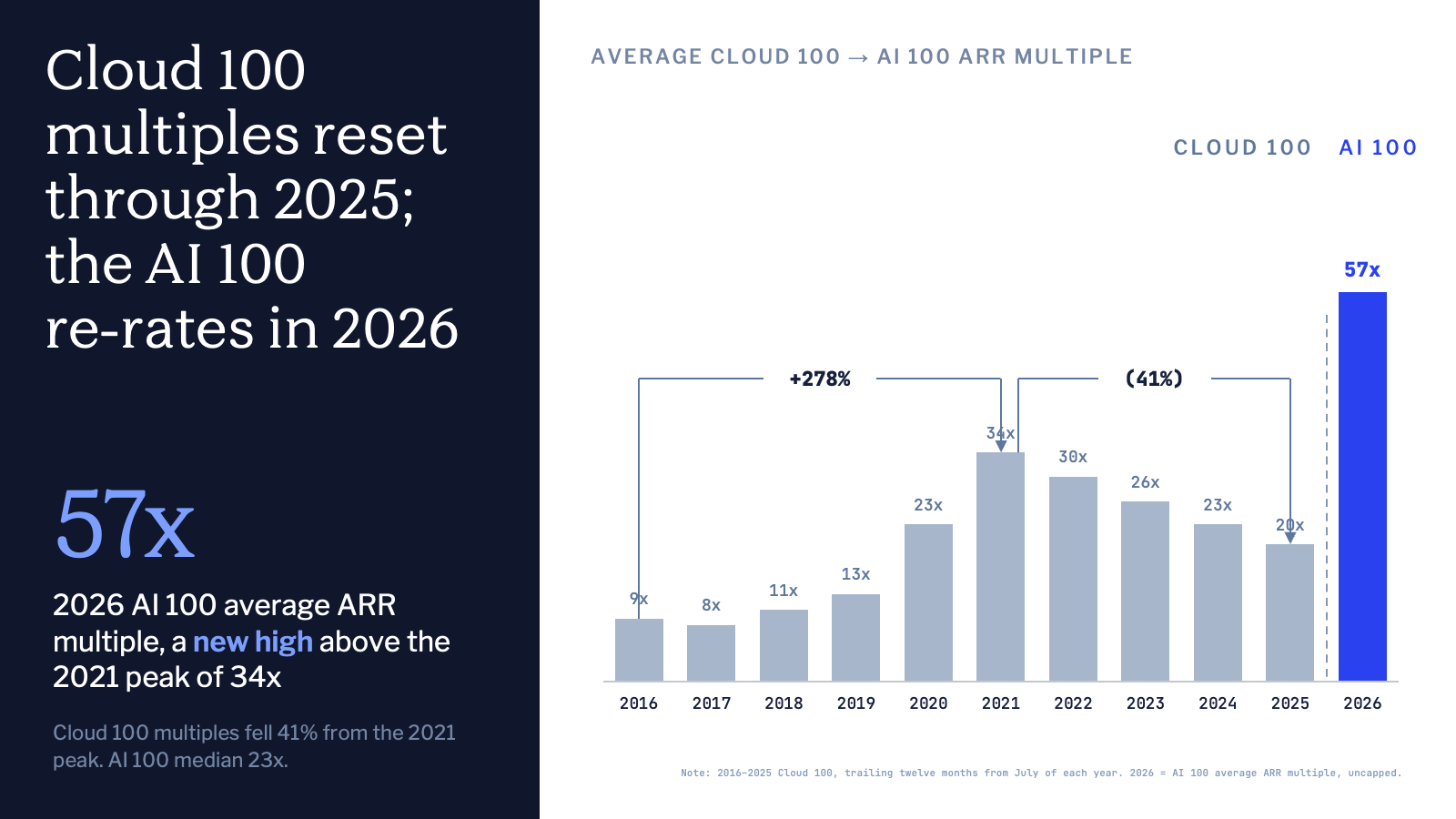
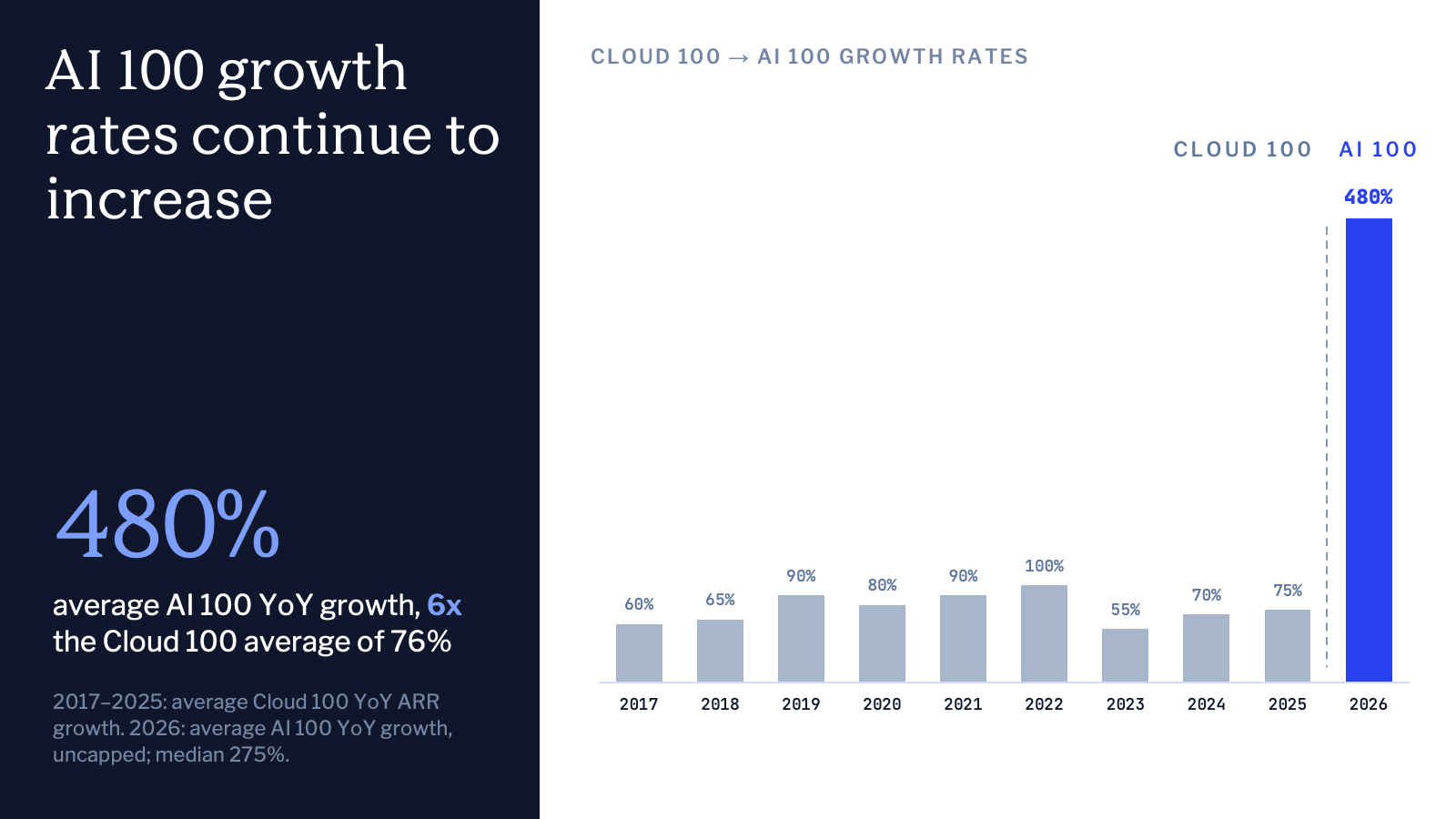
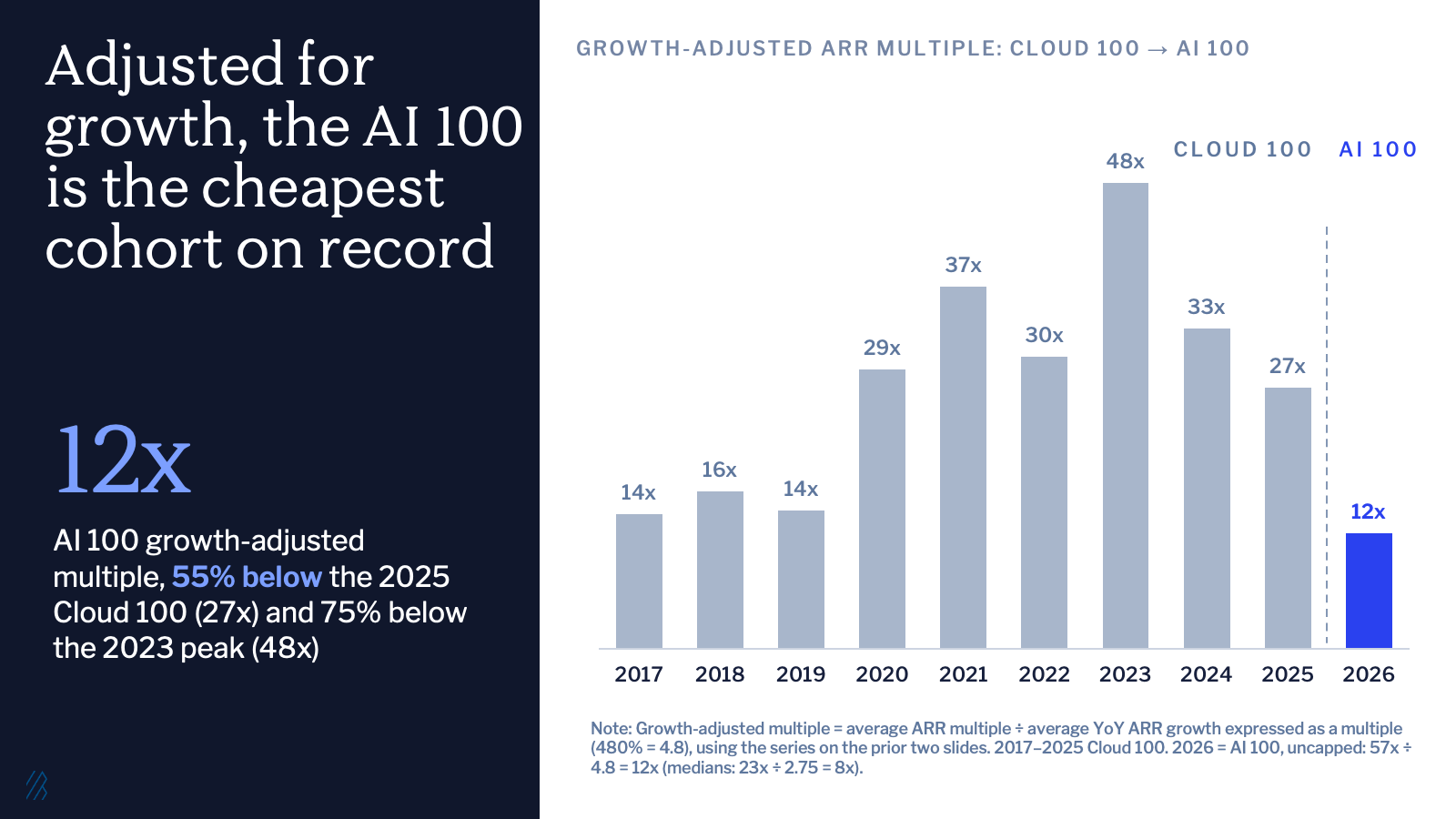
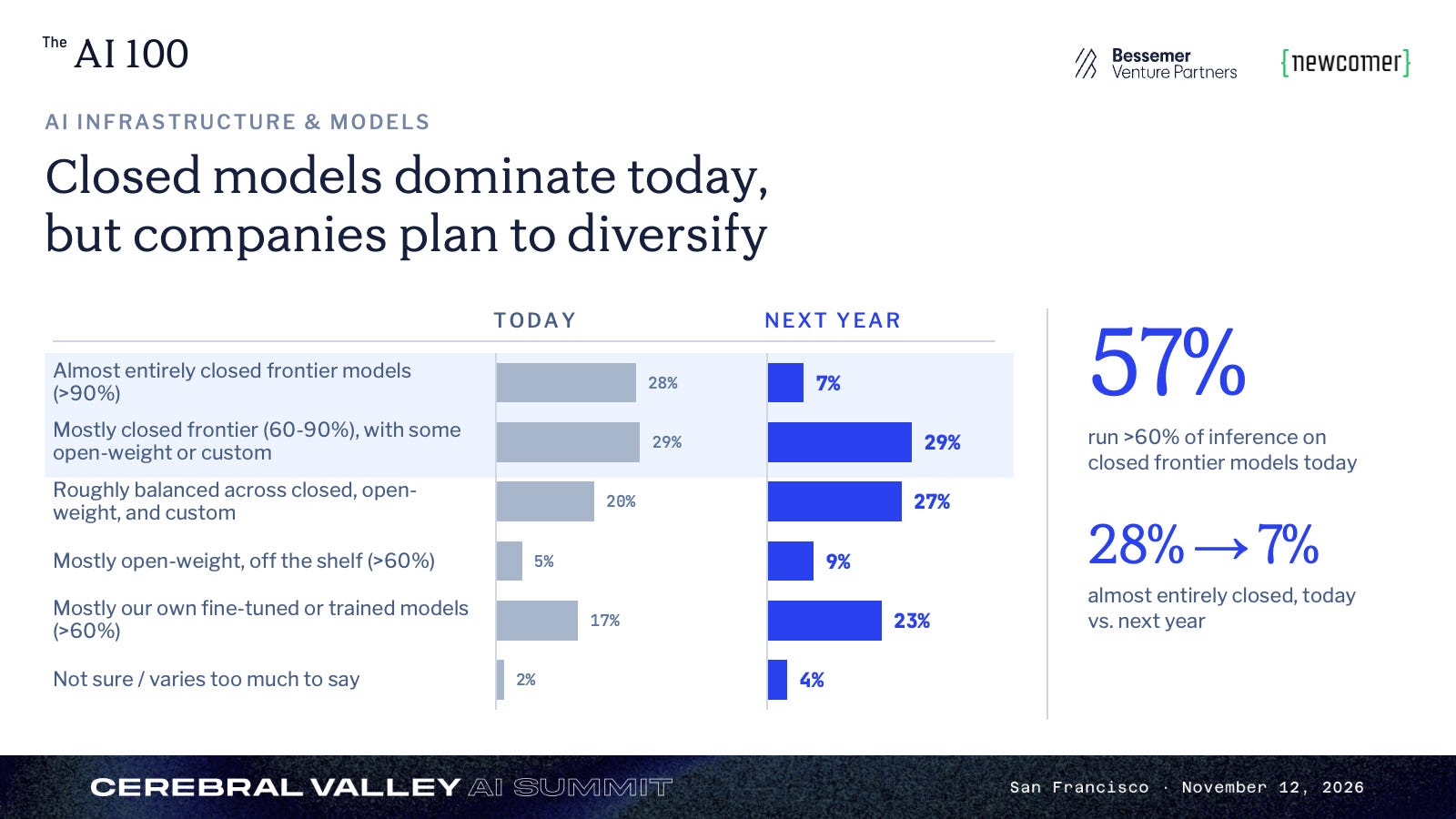
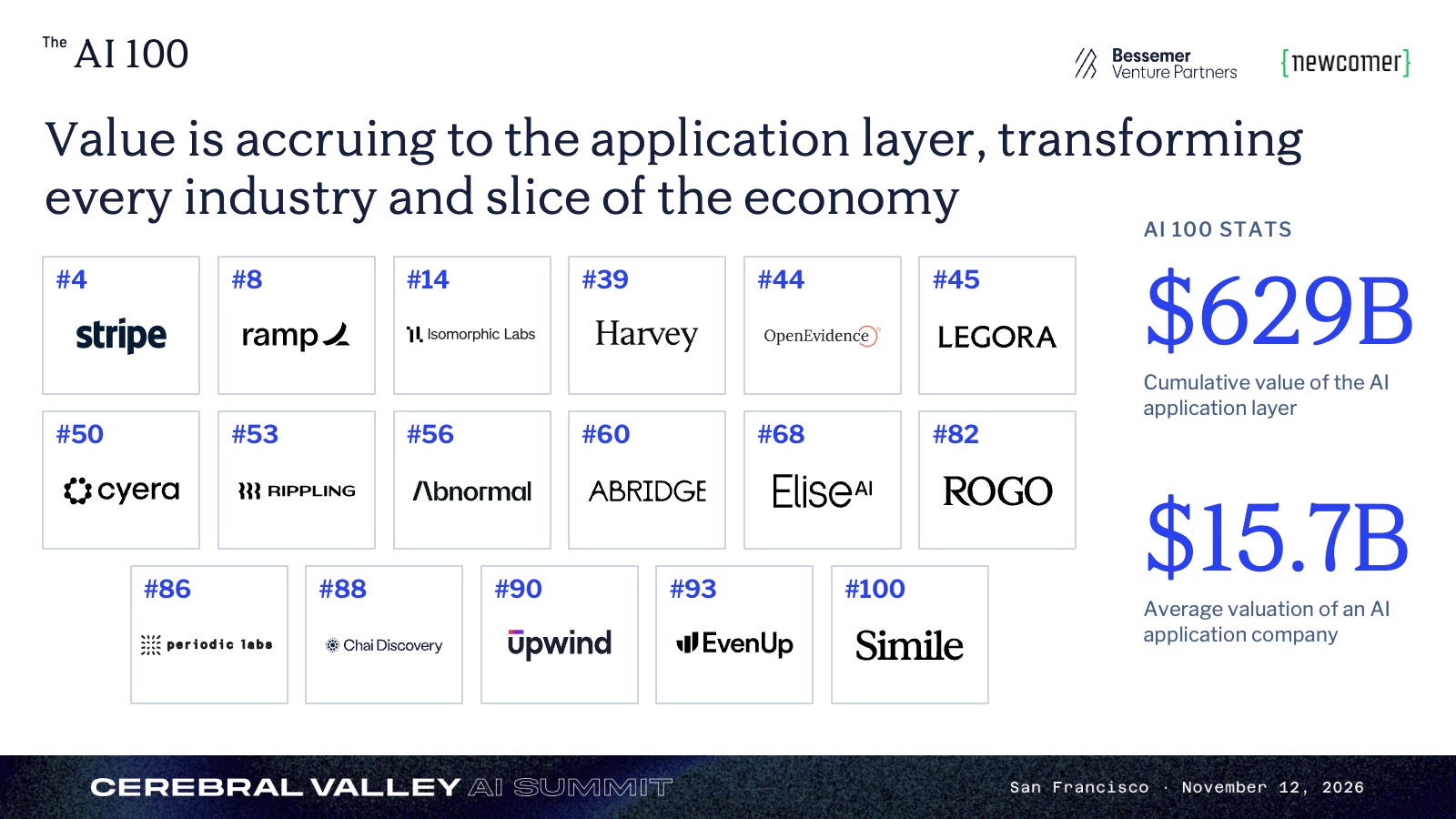
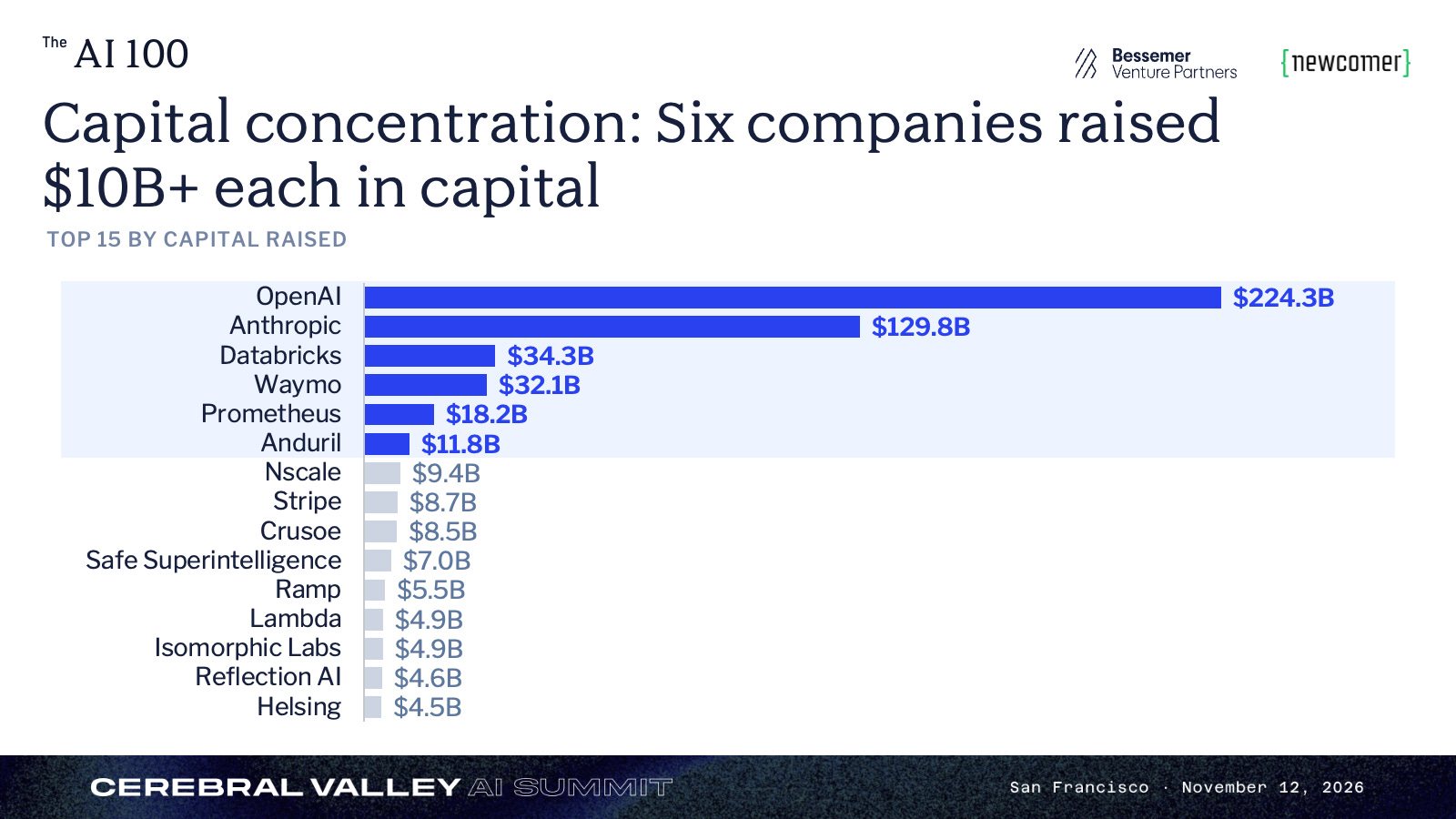
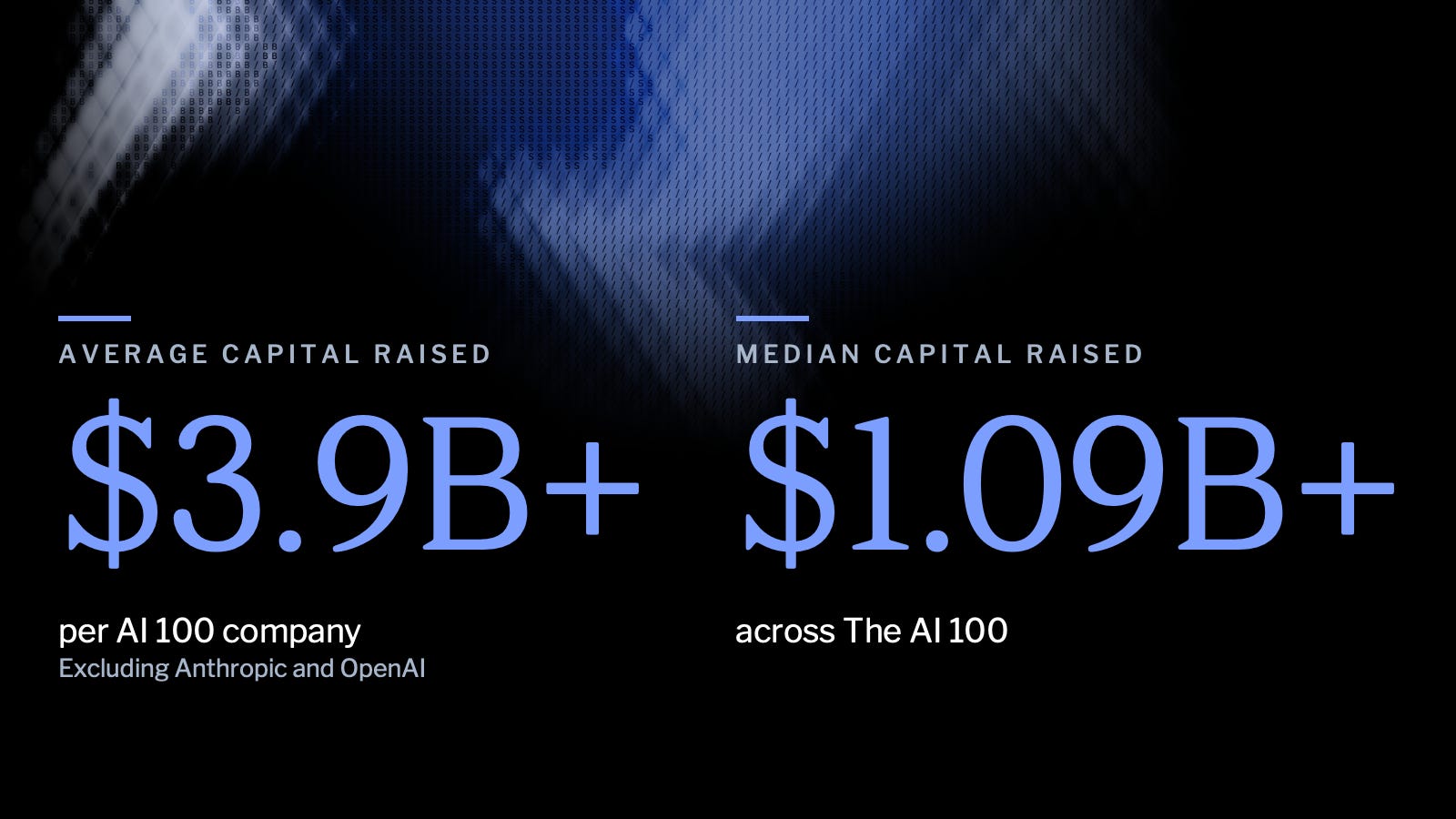
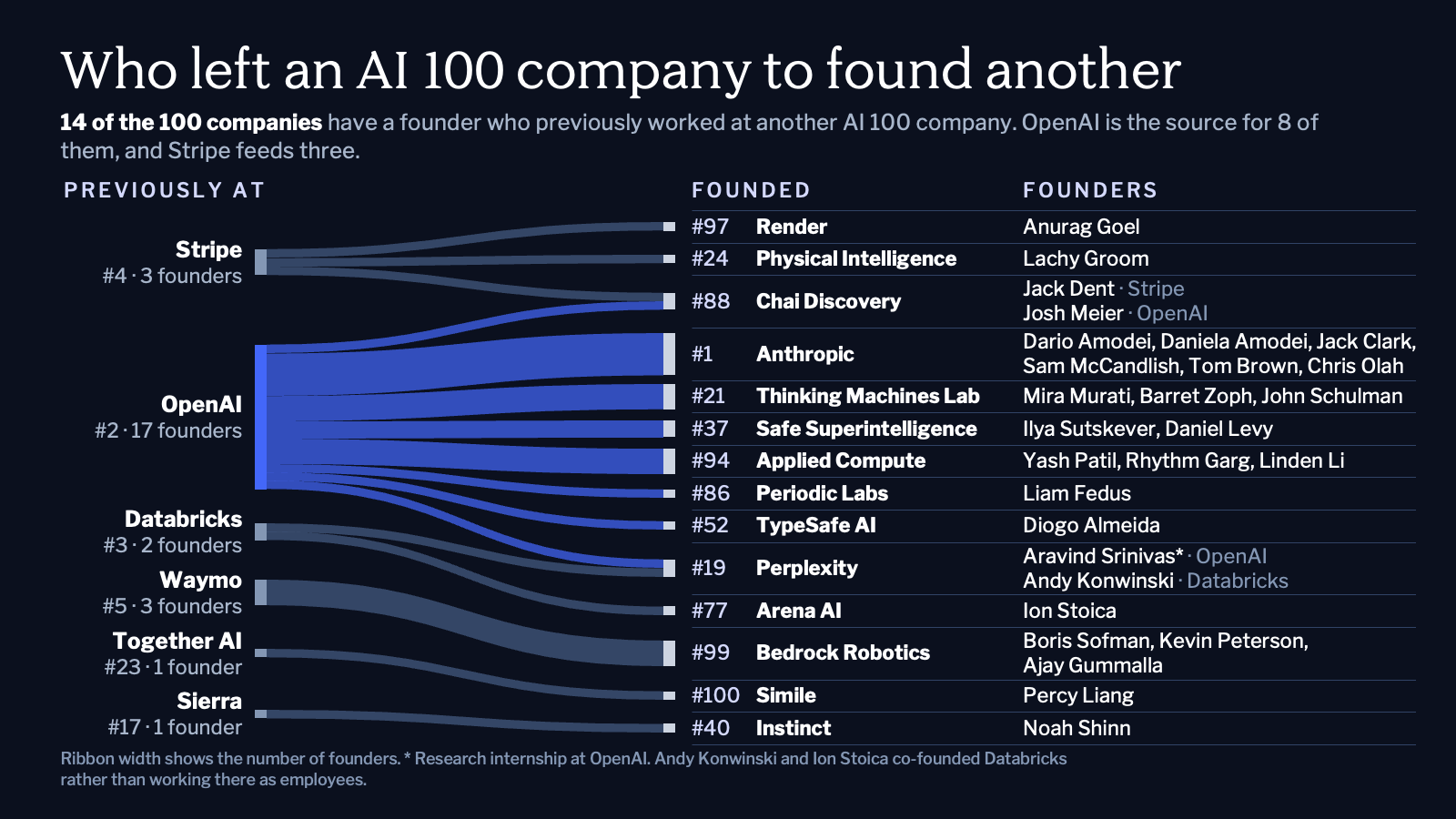
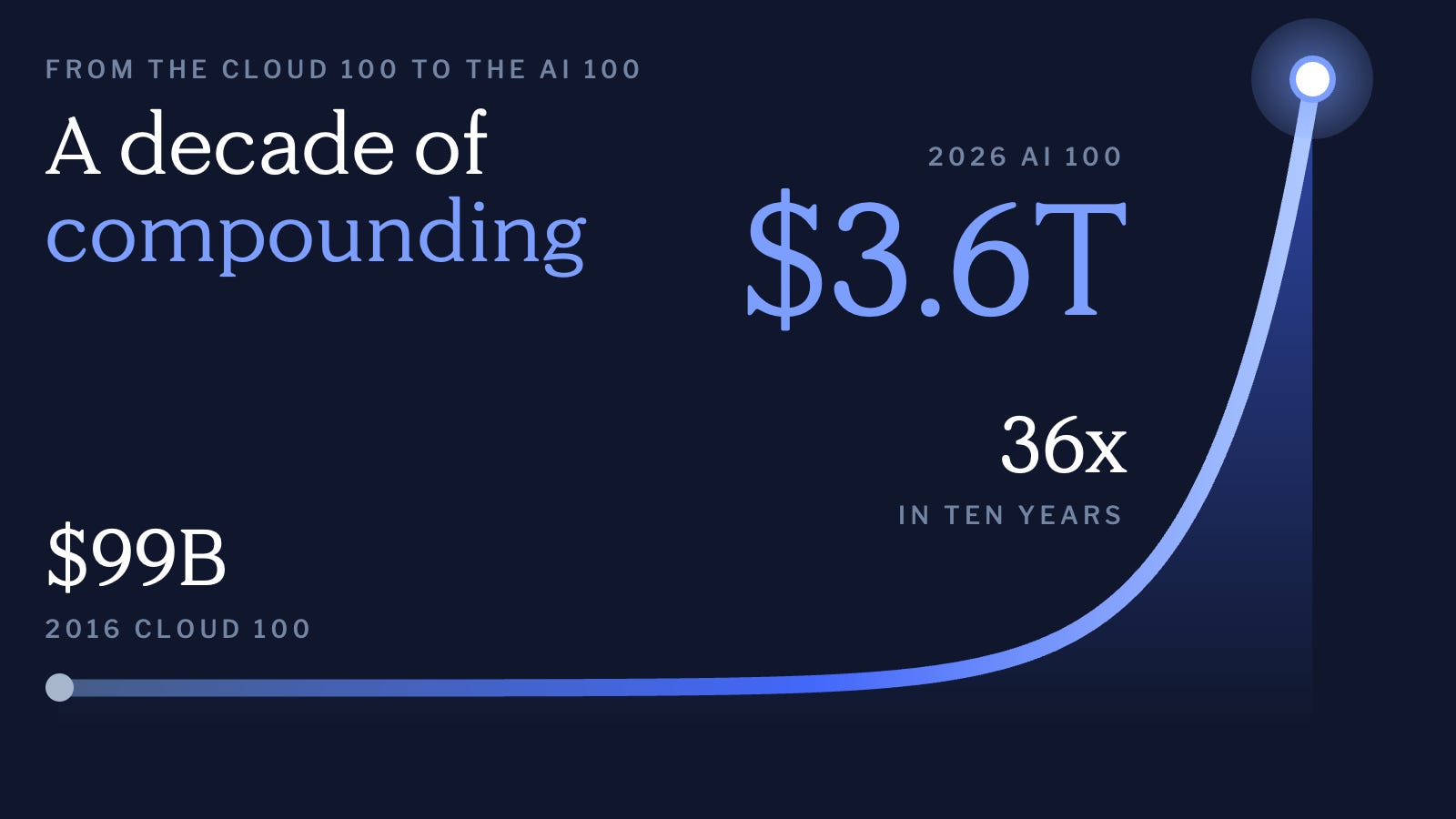
Bessemer’s Byron Deeter and Talia Goldberg broke down the AI 100 list, created in partnership between the firm and Newcomer. The data made it clear that AI startups don’t play by the same rules as cloud companies in Bessemer’s earlier index. The total valuation for the inaugural Cloud 100 list in 2016 was $100 billion; for the inaugural AI 100, it’s 36 times higher, at $3.6 trillion.
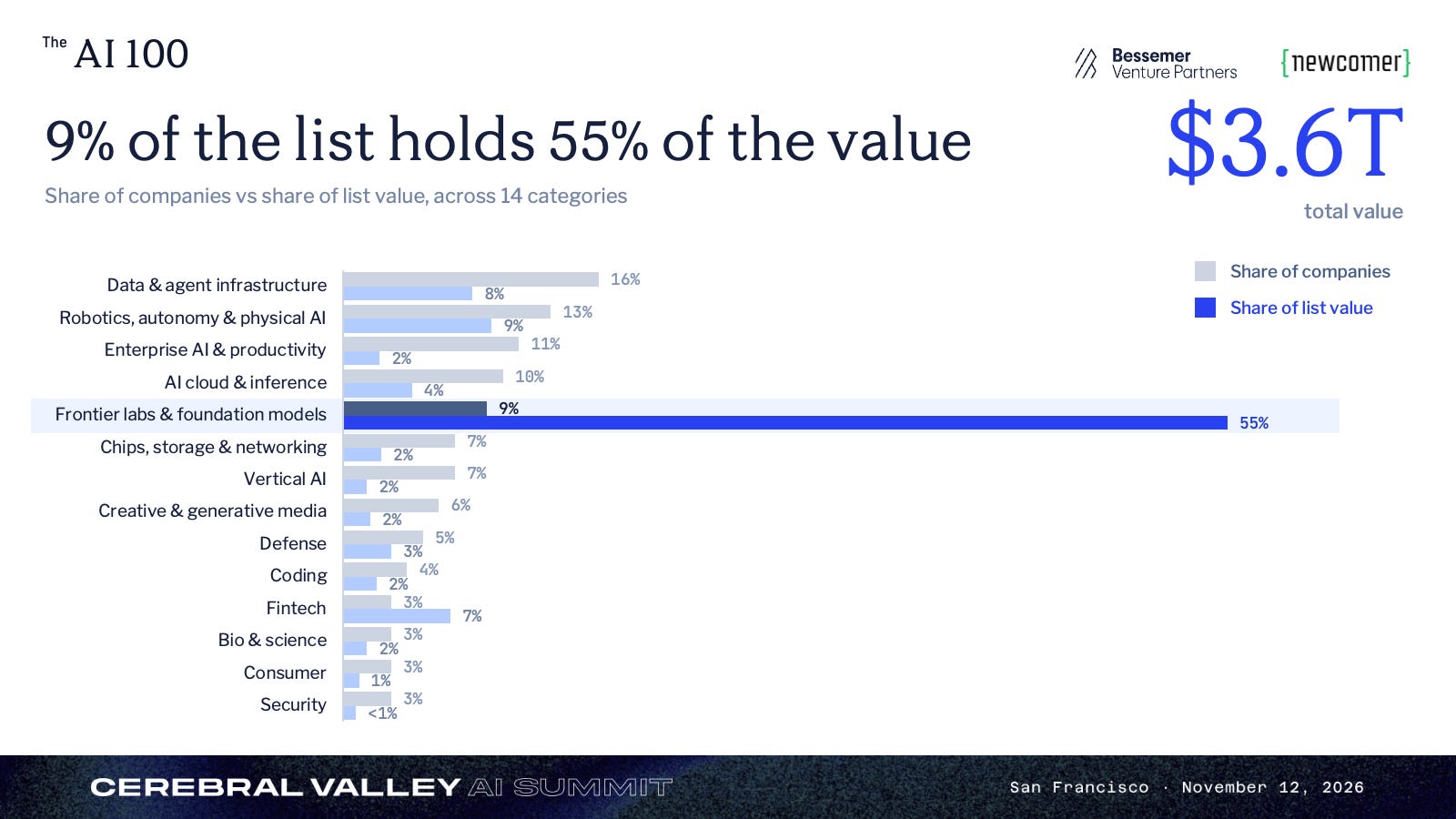
A lot of this value is concentrated in the big foundation model labs, especially OpenAI and Anthropic, which accounted for 55% of the valuation total. Startups on the list are also younger than their predecessors: 20% of the companies on the AI 100 didn’t exist two years ago.
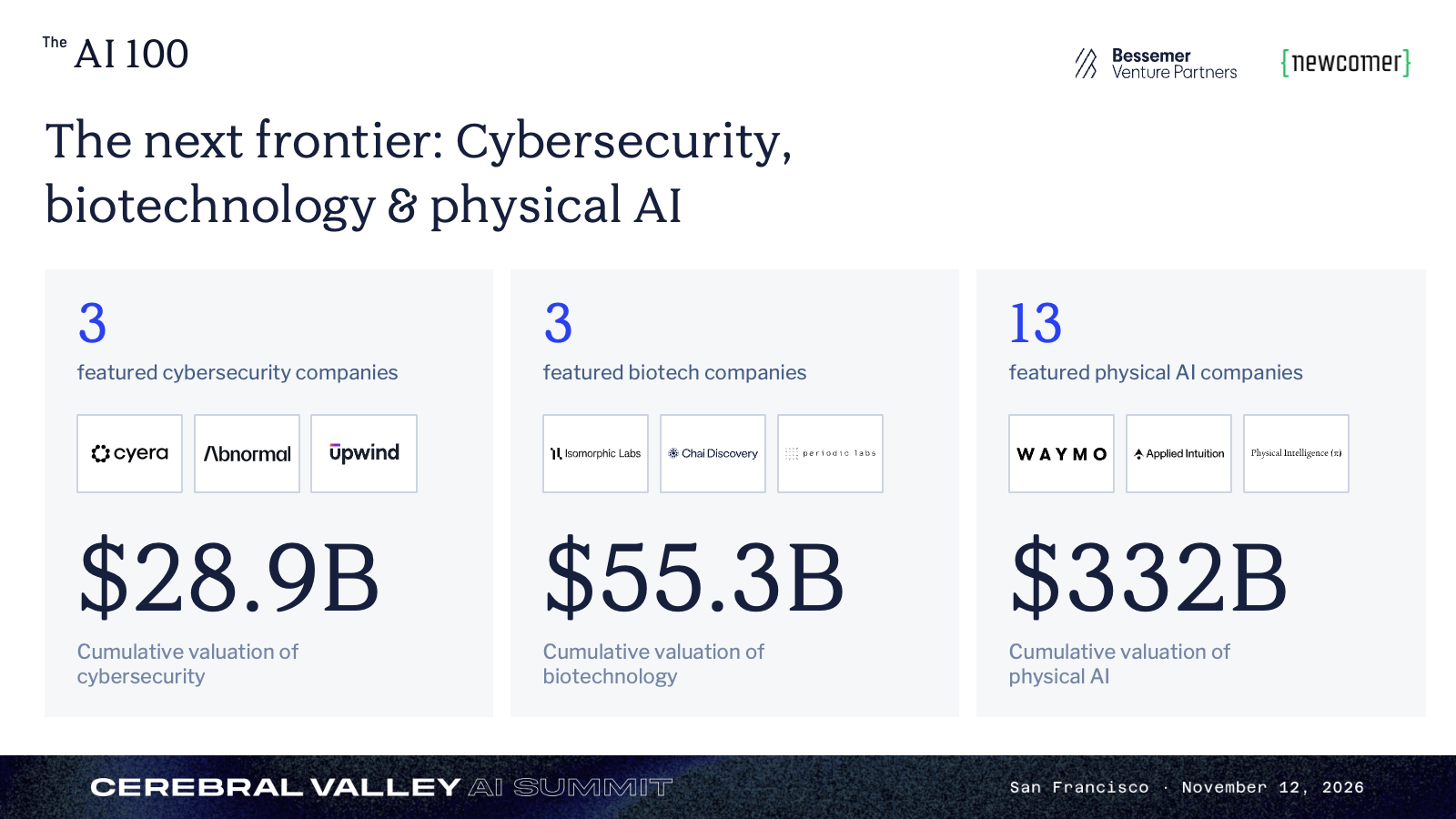
AI services startups were well represented on the application side, in categories like HR, legal, accounting, and customer service. Cybersecurity and biotech were promising categories that were underrepresented, said Goldberg.
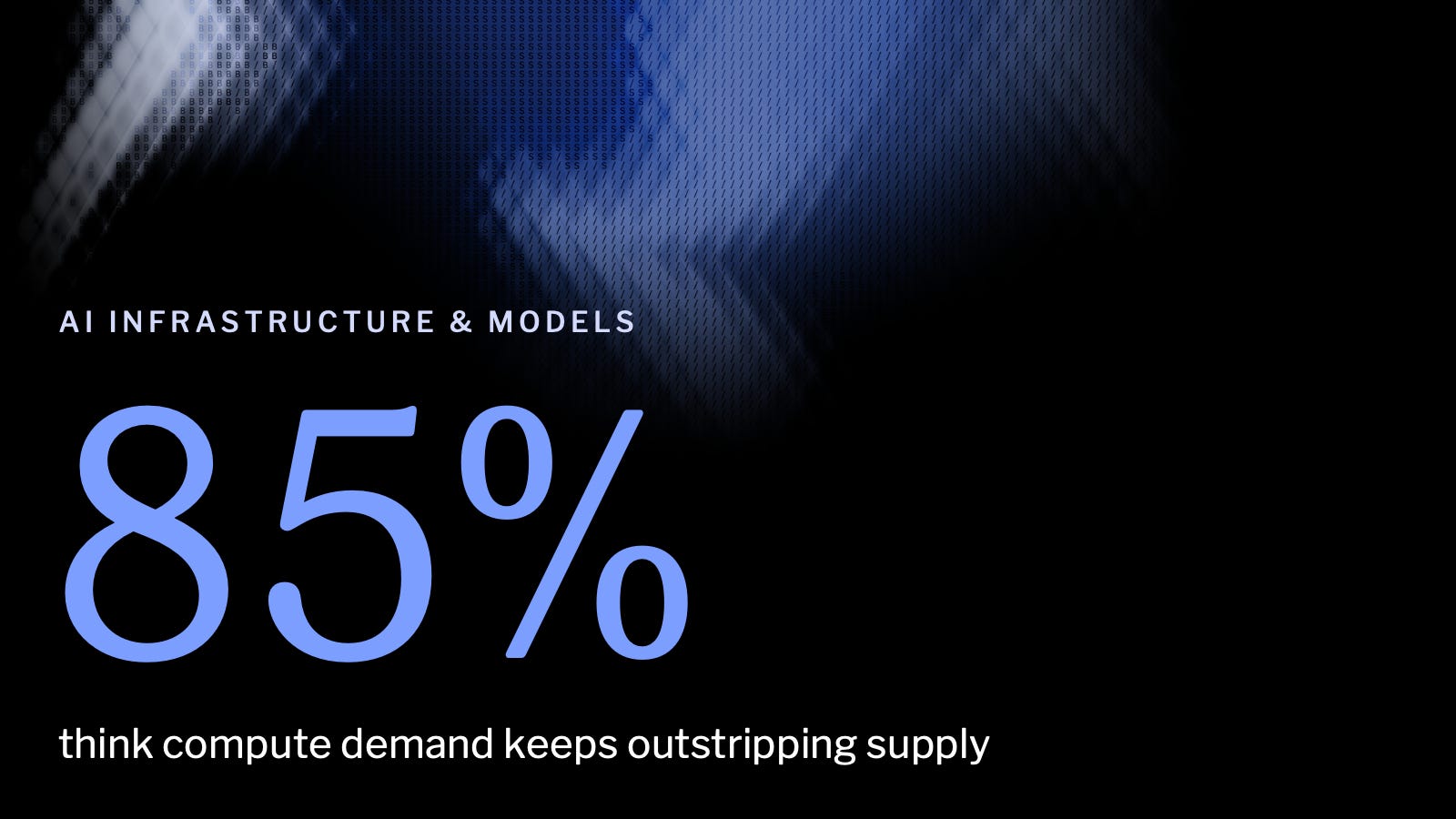
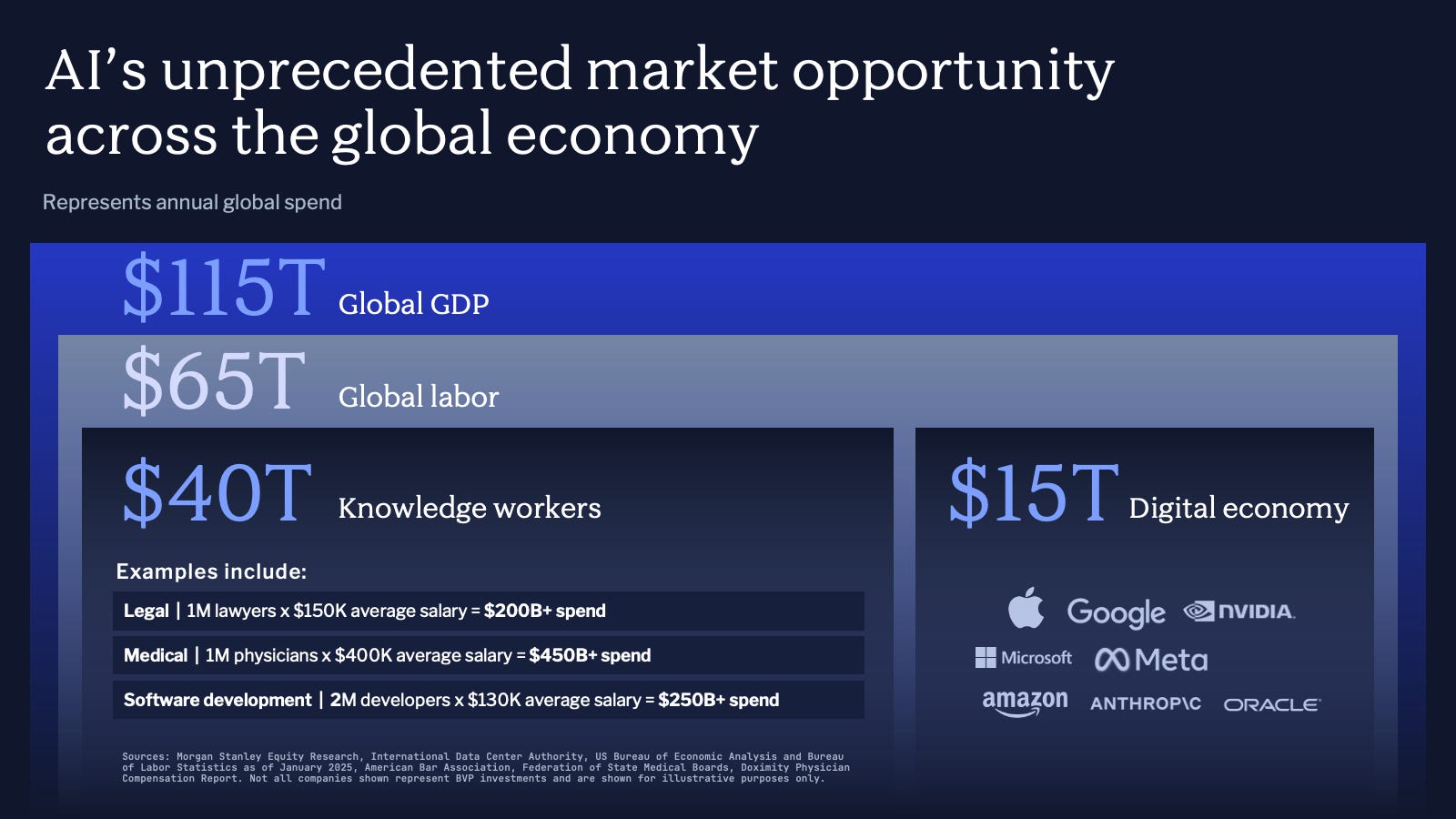
About $8 trillion of capex for the AI buildout is planned for the next five years, but for that to pay off, businesses would need close to $6 trillion of annual revenue to justify those expenses, per Bessemer’s data. Some of that will have to come from AI replacing parts of the labor force, Goldberg noted.
See the slides from the AI 100 presentation below:



Bubble Concerns Hit Even the Most Optimistic Tech Leaders (CVAI Show Survey)
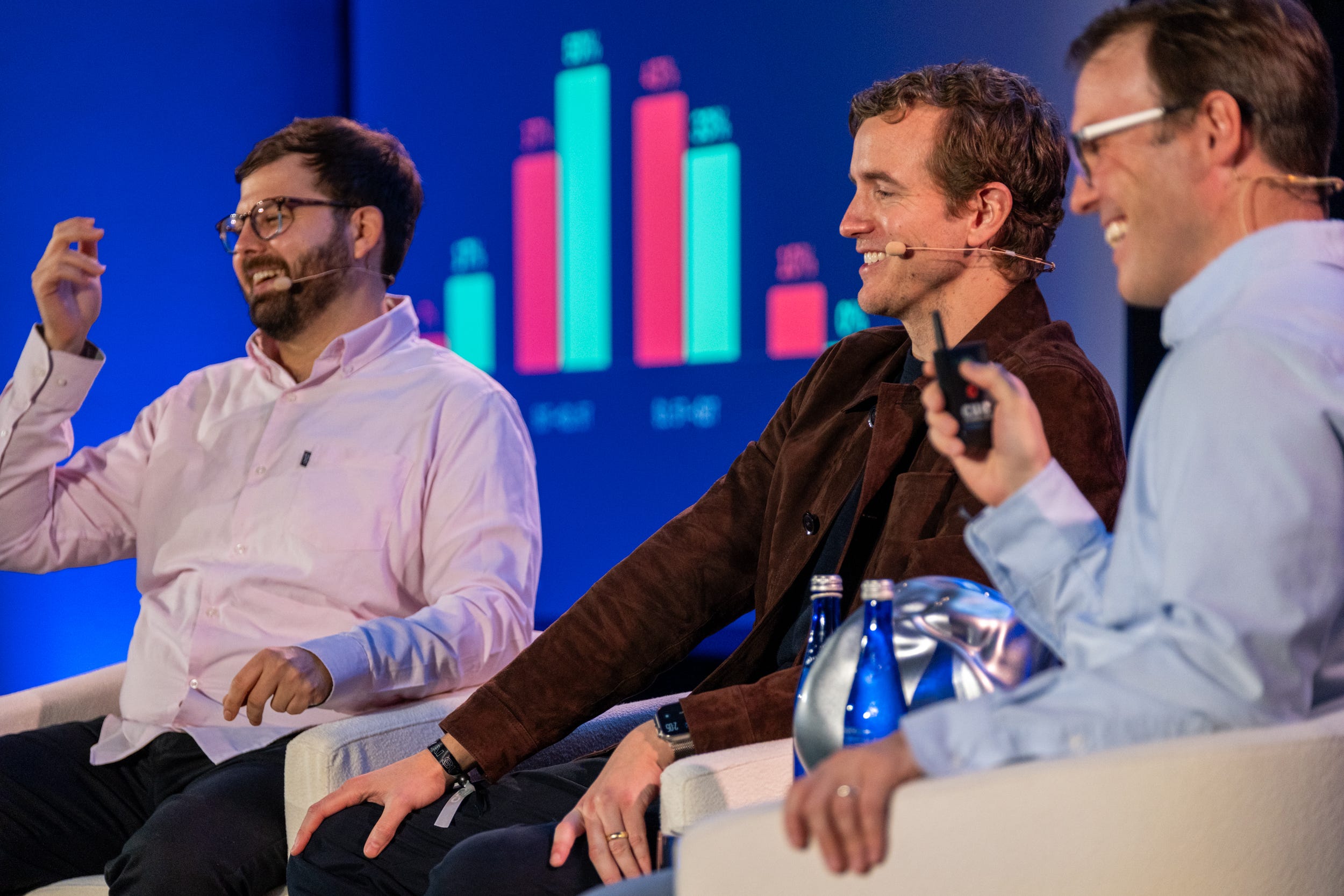
In our audience survey, 79% of respondents agreed that there was an AI bubble and 67% of them thought it was likely to pop in 2027 — and that was before Monday’s market swoon. Yet the room also thought that Anthropic’s market cap after the first day of trading would sit between $1 and $2 trillion.
Another stat of note: 64% of respondents were also hiring fewer people, and not a single person said that they were hiring significantly more because of AI.