


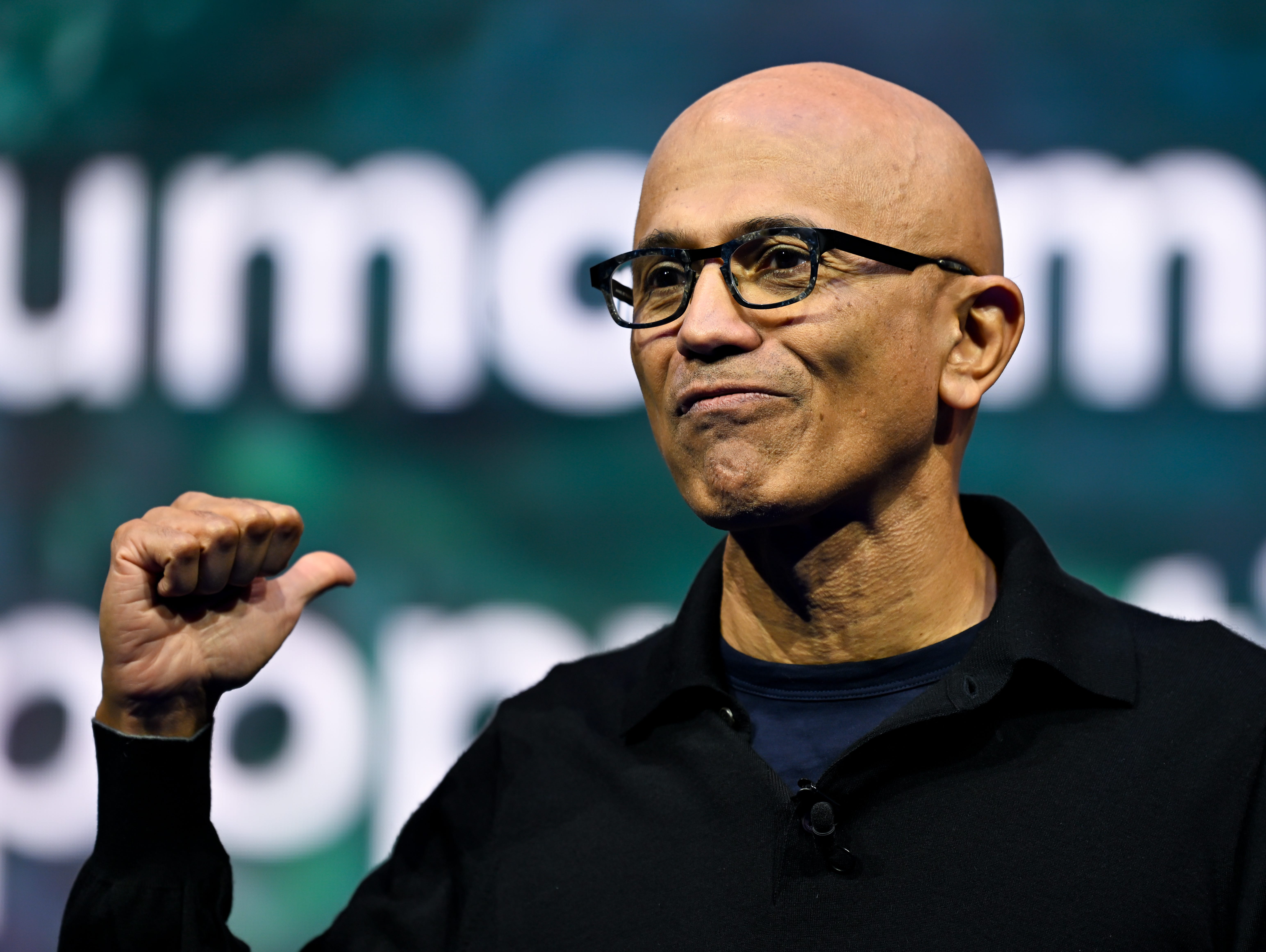
The legend of Satya Nadella is of an executive who took over Microsoft a dozen years ago after the troubled reign of Steve Ballmer, and saved the company.
He made Azure into a force and Office into a cash machine. In the AI era, Nadella moved faster than rivals to navigate another platform shift. He bet big on OpenAI, giving Microsoft early access to breakthrough models, and recruited a DeepMind co-founder to lead its internal AI effort when the OpenAI partnership was looking shaky.
It’s a legend I know well because I helped create it.
At the Wall Street Journal, I covered Microsoft during its AI renaissance, talking to Nadella and his deputies frequently, while chronicling a bet-the-company strategy that seemed to radically reshape its culture and products. Of all tech giants, how did stodgy Microsoft emerge as the winner in AI while its rival Google was in chaos? The answer was Nadella.
But the problem with legends is they’re unmoored from time and can outlive the truth. And time has not been kind to this one.
AI Implosion
Microsoft under Ballmer famously missed out on mobile. Nadella, to his credit, was early to generative AI. But age-old company problems of weak product design, questionable leadership selection, and organizational sprawl have Nadella looking like he’ll be run over by it all the same.
Since the beginning of the year Microsoft’s stock is off 19%, the worst performance among the Mag 7. It’s been walloped by a confluence of factors — among them the investor selloff of SaaS stocks and rising competition from other AI players — but the biggest problems are of its own making.
I’d been hearing a drumbeat of critiques from high level Microsoft sources for months, but that grew into a roar last week after Nadella announced he was re-doing its AI team. The company’s face of AI, Mustafa Suleyman was moving out of product oversight and into a new role building large language models. Jacob Andreou, a newish recruit from Greylock Ventures and previously a star product leader at Snap, is now overseeing Copilot products across the company. A collection of executives including Ryan Roslansky, who’s also the CEO of LinkedIn, will be overseeing Microsoft 365 apps.
In a note to the company, Suleyman said he was now able to “focus all my energy on our Superintelligence efforts.” It’s a type of face-saving PR spin that would be amusing for its cynicism if the whole situation wasn’t entirely predictable. Nearly every current and former Microsoft executive I talked to after Nadella brought Suleyman on anticipated the move would be a bust.
Last year I chronicled the issues Suleyman experienced since he joined Microsoft, including zero growth in consumer Copilot and a headstrong style that alienated its key partner, OpenAI. In an incident Microsoft employees still shake their heads about, he yelled at OpenAI’s then-CTO Mira Murati in a meeting, demanding access to its code (to be clear Microsoft has the rights to it, but the topic was sensitive).
To be fair, Suleyman is charismatic and articulates an appealing vision for AI more cleanly than Sam Altman or Dario Amodei. Far from being banished, his new role of overseeing model development is an important one as the company tries to catch up and lessen its dependence on outside models. Last week Microsoft released an image model underneath its MAI large model family that it said made MAI “a top three text-to-image labs in the world.” (It debuted at number three on the Arena leaderboards, which isn’t nothing, but not exactly a Gemini or GPT killer).
Still, his product legacy isn’t pretty. The consumer Copilot app he was tasked with reviving had 6 million daily active users in February, according to CNBC citing Sensor Tower. ChatGPT had 440 million that same month; Gemini had 82 million (so much for making Google “dance”). Even Claude, which is far from a major player on the consumer side, had surpassed it at 9 million by March.
The businesses Suleyman didn’t oversee fared no better. Adoption of Microsoft 365 Copilot — an enterprise product long run by a different team, confusingly — has been a rolling disaster, barely mustering 15 million paying seats on a global commercial customer base of 450 million. GitHub Copilot, the earliest and once-widely hailed AI coding tool, has lost the narrative first to Cursor and then to agentic tools like Claude Code to a point that it’s barely in the conversation.
Microsoft in a statement pushed back on the notion that their AI products are a dud with customers: “The idea that Copilot isn’t growing just doesn’t match the facts. We’re seeing more and more large-scale deployments and increasing daily usage,” a spokesman emailed me. He compared the 15 million Copilot enterprise users to disclosures from Google, OpenAI and Anthropic, all of which had a fraction the number of enterprise seats.
It’s hard to know how to make fair comparisons among these figures, but given the momentum all those companies and their models have, I’d love to check in on those numbers in a year.
Talent Troubles
The number of recent leadership changes at Microsoft, a company of lifers, has been stark. The head of the Azure AI platform, Eric Boyd, is leaving for a new role at Anthropic, where he’ll oversee its infrastructure team, I’ve been told by multiple sources. Also gone is the CEO of GitHub, Thomas Dohmke, who left last year to start his own company. Phil Spencer, the respected head of Xbox, announced his retirement last month, and his deputy Sarah Bond followed him out the door. Rajesh Jha, the longtime EVP who oversaw Microsoft 365 and Windows, is retiring as well.