


The Week in Short
SpaceX’s outlandish S-1 is an all-in bet on Elon Musk. We share our condolences for the loss of Madrona managing director Soma Somasegar. Eric asks Wired Editor-in-Chief Katie Drummond why so many tech leaders want to buy her out of a job. Outsized funding rounds are eating up most venture dollars. Mercury, Exa, Decart, and several others join the 9-figure deal club. Google leans into agents at I/O. Lightspeed GP Baier-Lentz goes solo. Meta and Intuit slash thousands of jobs and blame AI. China’s purported love of AI may not be what it seems. Compute set to trade like a commodity. Trump corruption reaches new extremes with $1.8 billion “anti-weaponization” fund.
The Main Item
SpaceX Numbers Show That Investors Will Be Betting Entirely on Musk’s Grandiose Promises
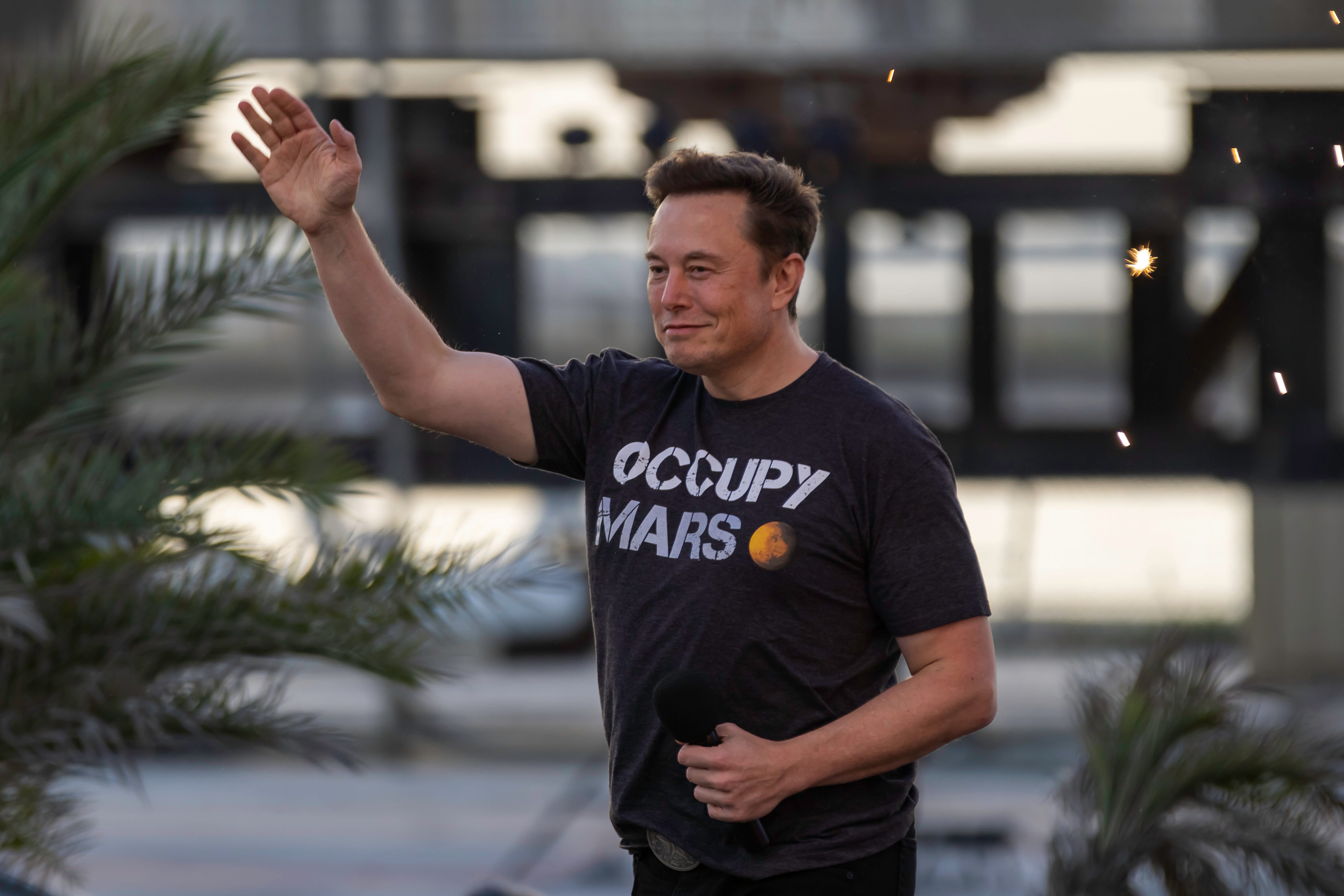
The public markets effectively laughed Adam Neumann out of the room when he tried to sell them on the idea that his co-working company was actually in business “to elevate the world’s consciousness.”
Elon Musk is trying to do Neumann several orders of magnitude better. Musk is bringing “the light of consciousness to the stars.”
You’ve got to read SpaceX’s full mission statement for yourself. This is what, with the advice of basically every banker known to man (including some of the same suits who tried to take WeWork public), SpaceX is telling the world:
Our mission is to build the systems and technologies necessary to make life multiplanetary, to understand the true nature of the universe, and to extend the light of consciousness to the stars. To do this, we have formed the most ambitious, vertically integrated innovation engine on (and off) Earth with unmatched capabilities to rapidly manufacture and launch space-based communications that connect the world, to harness the Sun to power a truth-seeking artificial intelligence that advances scientific discovery, and ultimately to build a base on the Moon and cities on other planets.
SpaceX’s desire to get men on Mars is the least outlandish thing about this company.
SpaceX is far and away the most unfocused, loss-generating, wanna-be trillion dollar-plus market cap company the world has ever known. The company amounts to:
a rocket-launch company with $4.1 billion in revenue +
a satellite telecommunications business growing roughly 50% year over year +
a degraded version of Twitter that generates less revenue than when Musk bought the company +
an AI lab that burns $2 for every dollar it brings in and has lost its entire non-Musk founding team +
an endless string of promises about what it will become (space data centers & enterprise applications worth about 2/3 of current annual U.S. GDP).
Of course, unlike Neumann, Musk has delivered on some amazing things and had substantial business success. SpaceX rockets are reusable and dependable. Starlink is a profitable and fast-growing business. And by the way, Musk already has another company with a trillion-dollar market cap that had attracted plenty of doubters.
Musk has continually punished the haters, short-sellers, and the (yours truly) media naysayers with a mix of impressive results and seemingly undying loyalty from enough investors to fund his wildest dreams. But this IPO, in which SpaceX hopes to raise $75 billion at a $1.75 trillion valuation, could push even Musk die-hards to the limit. The prospectus reads, “By moving beyond the only home we have ever known, we ensure species-level redundancy and that the light of consciousness will not be tied to a single planet subject to the inevitable hazards of a harsh and vast universe. We do not want humans to have the same fate as dinosaurs.”
It’s a lot, as are the moonshot projections, which several high profile anonymous accounts on X were quickly calling out — a valuation approaching $2 trillion for what is effectively a $6.6 billion adjusted EBITDA business.
Here are a few key takeaways from the SpaceX S-1:
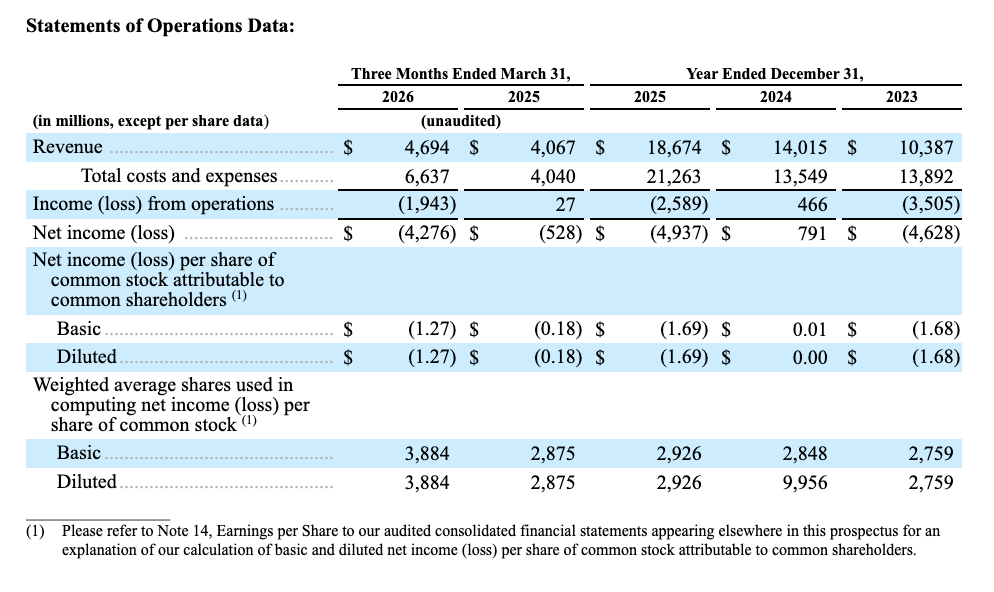
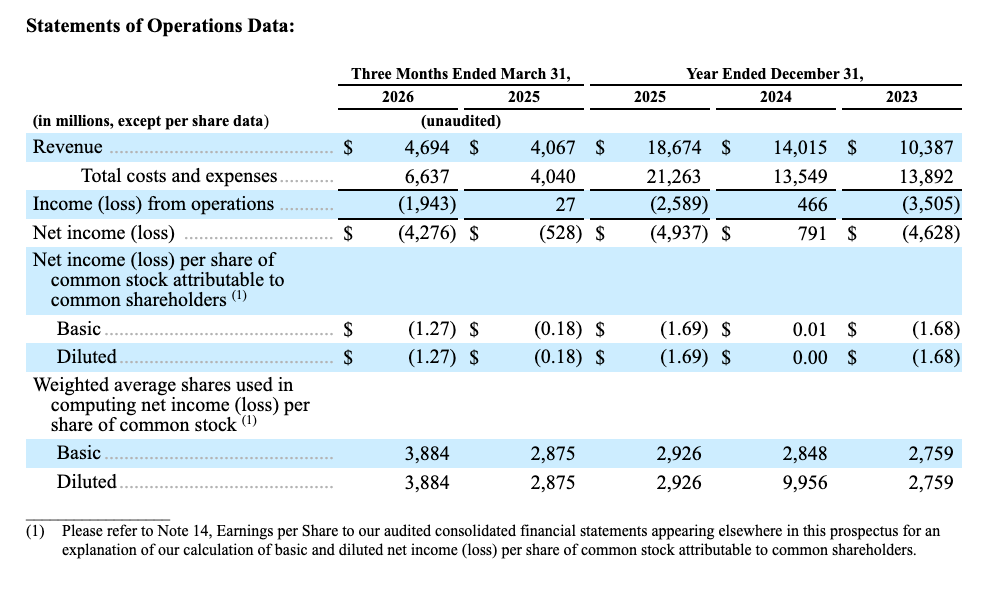
The financials are worse than we expected. SpaceX’s revenue may have jumped 33% from last year, reaching $18.7 billion, but losses grew to $4.9 billion for 2025 after the merger with the money-bleeding xAI. The only profitable year listed in the S-1 was 2024, at just $791 million.
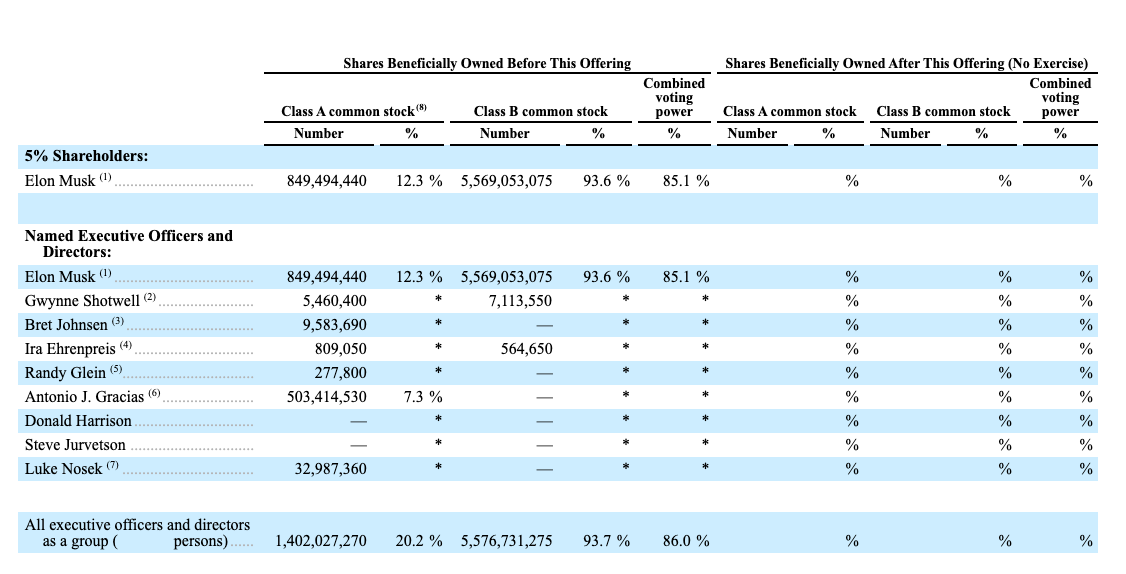
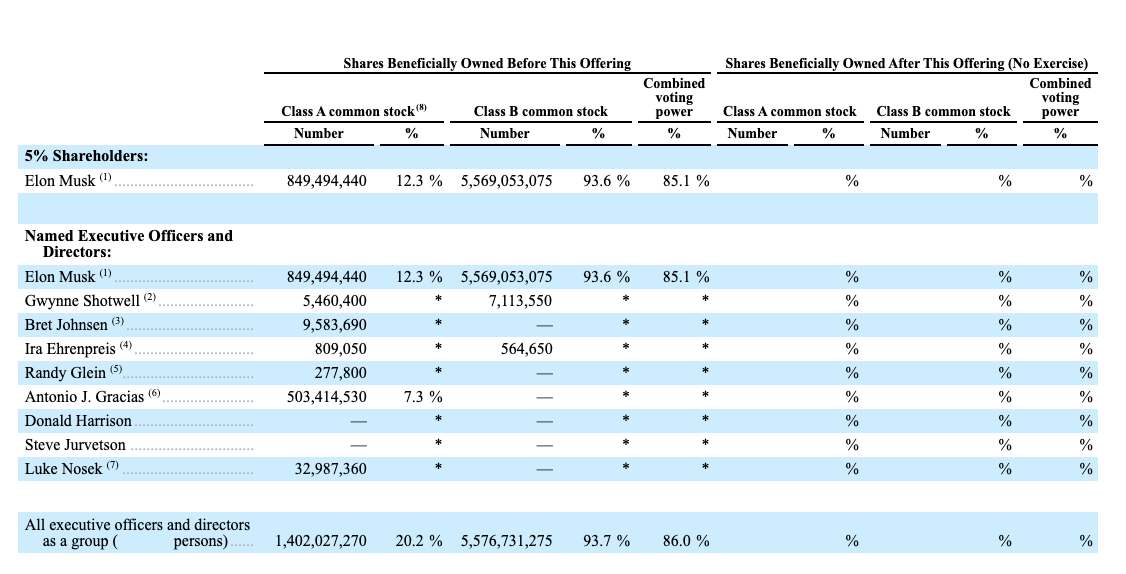
It’s Elon’s company, public or not. Musk will own 85.1 percent of the SpaceX voting shares, giving him near-total control and limiting the ability of other shareholders to have any say in the company’s operations. This degree of concentration is large even for the tech industry and is listed as a risk in the filing.
The business of X, formerly Twitter, is shaky. While X has 1.3 billion active accounts (defined as in use within the last 12 months), its ad revenues haven’t recovered from the staggering $595 million decline in 2024 that resulted from Musk’s dismantling of content moderation. Subscription revenue, which comes from 6.3 million active paying subscribers across consumer offerings like X Premium and SuperGrok, has not made up for the loss in ad dollars. Still, investors and lenders involved in the Twitter buyout have done well by Musk’s machinations.
A few comparatively lesser-known names stand out as huge winners among SpaceX investors. Valor Equity Partners’ Antonio Gracias and Gigafund’s Luke Nosek are listed on the cap table as members of the board of directors. Gracias owns around 4% of SpaceX through various fund vehicles, per The Information, and is listed personally as owning 7.3% of Class A common stock, or around 503 million shares. Nosek owns around 32 million Class A shares.
Other VC firms aren’t listed as 5% or larger stakeholders, but do own a sizable portion of the company. Founders Fund has a 3.5% stake, which could pay out into a $60 billion gain at the hoped-for $1.75 trillion valuation; it put in a little more than $600 million, per a source familiar with the numbers. Sequoia owns around 1.5%, which could generate around $20 billion in returns; the firm invested around $2 billion total across SpaceX, xAI, and X while they were separate companies, with $800 million of that direct into X, per a source familiar. Shaun Maguire took the lead on Sequoia’s deals, while Nosek led Founders Fund’s investment before leaving to start Gigafund.
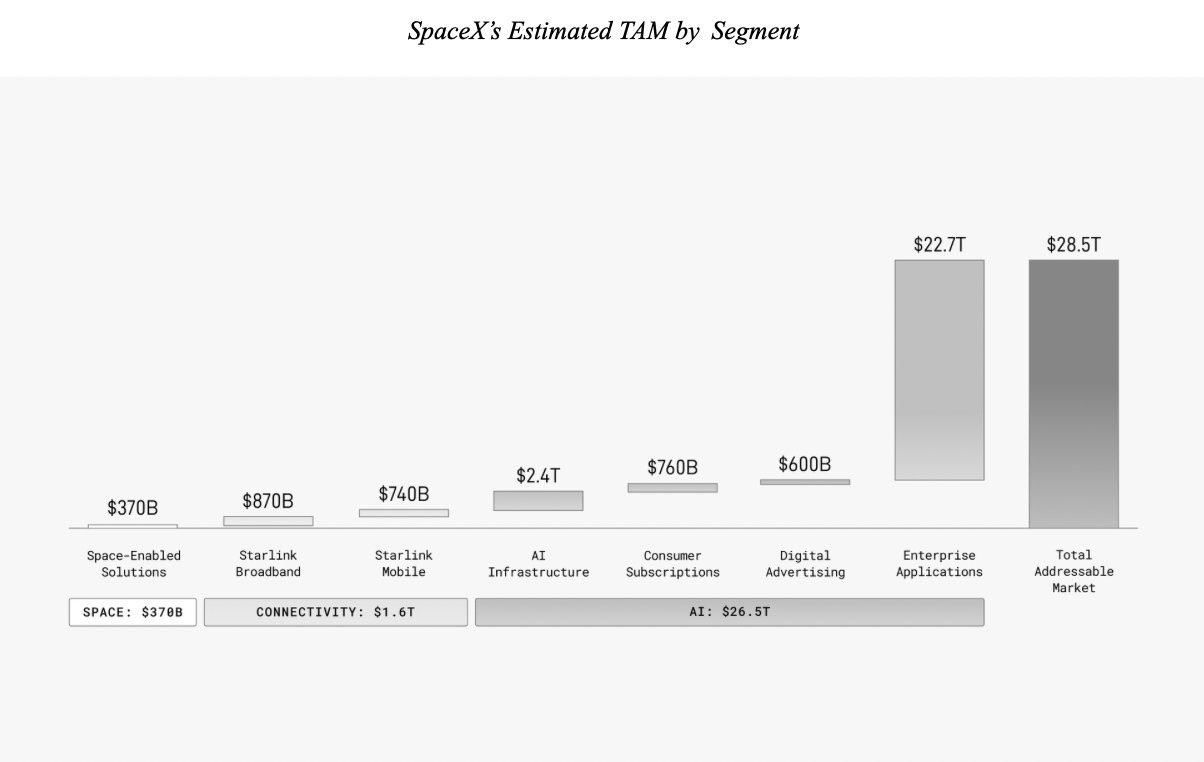
In a claim so bold that it would make Neumann blush, SpaceX defines its Total Addressable Market, or TAM, as a whopping $28.5 trillion across all its businesses (with these figures excluding China and Russia). AI unsurprisingly makes up $26.5 trillion of this, with the vast bulk of it in enterprise software and just $370 billion in “space enabled solutions.” Starlink connectivity could be worth up to $1.6 trillion.
Hype aside, Musk’s amassing of compute is poised to bring in substantial revenues and could be a big growth driver. The S-1 details Anthropic’s deal for the Colossus compute cluster, with the xAI rival paying around $1.25 billion a month through May 2029 for data center capacity.
SpaceX is playing some games around stock availability. It’s initially planning to have a small float but then will allow more shareholders to sell, especially if the stock is trading at a premium to the IPO price. The company seems to want to get onto the Nasdaq 100 quickly, creating more early buying pressure.
Unsurprisingly, space-focused founders and investors were thrilled to see the S-1 drop. Founders Fund partner and Varda co-founder Delian Asparouhov was pleased with the full-throated endorsement of orbital manufacturing as a future market. As Tom wrote yesterday, the pitch of a Muskworld company is not really about how it looks now, but what you believe it could be.
The SpaceX news was part of a remarkable week for the industry, coming on top of the verdict in the Musk versus Sam Altman legal showdown and leaks about an imminent OpenAI IPO filing. Nvidia, still the public markets’ main vehicle for AI wagers, reported another stellar quarter with revenue up 85% year over year. And Anthropic is projecting its first profitable quarter on extraordinary revenue gains, per the Wall Street Journal, and is expected to soon pursue an IPO of its own.
It’s fitting that Musk will dive in first. But little is predictable about what might come next.
Newcomer Podcast
WIRED’s Katie Drummond on Elon, Trump & Silicon Valley's War on the Press
Katie Drummond, global editorial director of WIRED and host of Uncanny Valley, came on the Newcomer Podcast this week to talk about the simmering war between tech and media.
From surviving the Gawker bankruptcy to now running one of the most scrutinized publications in tech, Drummond doesn't hold back on why certain tech figures want to buy or dismantle WIRED, why so much of Silicon Valley turned toward Trump, and what serious tech journalism looks like in 2026.
In Memoriam
Soma Somasegar, Managing Director at Madrona Ventures, Passes Away Unexpectedly
by Tom Dotan
The Seattle-based VC firm Madrona announced this week that much-loved managing director S. “Soma” Somasegar had died unexpectedly, eliciting an outpouring of remembrances in the venture and Seattle tech communities. He was 59.
Somasegar had been a longtime executive at Microsoft before joining Madrona in 2015. He was close with CEO Satya Nadella, with whom he co-owned a local cricket team.
While people should be remembered for much more than their professional output — he leaves behind a wife and two daughters — Somasegar was always a very kind, generous, and deeply knowledgeable VC who was happy to act as a resource to journalists and others who sought his help.
When I started covering Microsoft three years ago and first traveled to Seattle, he and his team set up a number of founders from their portfolio to meet with me in their offices overlooking the Puget Sound. He gamely sat through hours of my questions.
He wasn’t just pitching his book. Somasegar was willing and eager to pass along tips, discuss industry trends, and speak honestly (and on the record!) about Microsoft. If I ever texted, he’d always respond, often within seconds, while offering to set me up with others in his network.
He went far above and beyond the transactional interactions that are common among reporters and sources; he genuinely liked to help. For whatever it’s worth to his family, friends, and co-workers, know that it was deeply appreciated here. He will be missed.
Madrona has set up a page for people who knew him to share their memories and stories.
One Big Chart
Over 80% of VC Investment Now Going to Mega-Deals
It’s no surprise to Newcomer readers that a select few AI startups have accounted for a big chunk of venture funding over the last few years.
But the divide is more stark than ever for the first 5 months of 2026, with 80% of total deal volume and $232 billion in total capital going to these mega-rounds, per Crunchbase.
The chart provides a nice view of the secular shift in VC investing, with much larger rounds going to a smaller number of companies.