


The Week in Short
Jeff Bezos is the latest to catch AI-buyout fever as OpenAI and Anthropic flirt with private equity. The latest data dump from Carta shows large, recent venture vintages outperforming everything else. Cybersecurity startups Cloaked and Xbow raise shiny 9-figure funding rounds. OpenAI’s plans for X-rated chats face internal objections while xAI is hit with an “undressing” lawsuit. President Trump’s cash grab on the TikTok deal is getting a little scrutiny. A profile of Dario Amodei and the San Francisco AI scene misses the mark. Carl Eschenbach returns to Sequoia Capital as a full-time VC. Defense tech startups aren’t yet playing a big role in the Iran war, with the exception of drone-makers like SpektreWorks and Eric Schmidt’s Merops.
The Main Item
Bezos Eyes $100 Billion Buyout Fund for AI-Enhanced Manufacturing
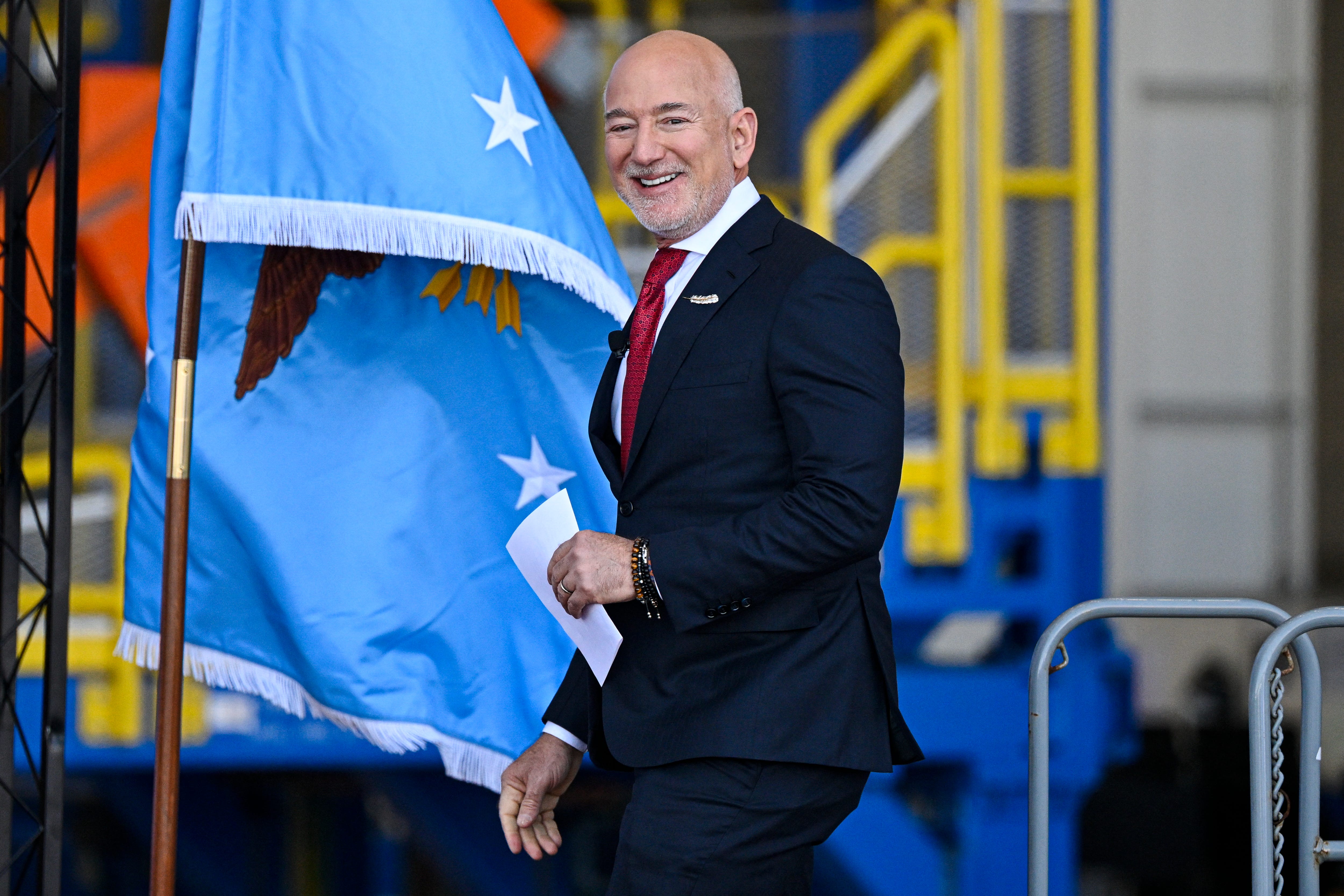
Venture investors that have bet heavily on the idea of acquiring established companies and injecting them with AI now have some formidable imitators: Jeff Bezos, private equity giants including Blackstone and TPG, and the foundation model leaders themselves.
Bezos is looking to raise $100 billion for what he’s been pitching to global investors as a “manufacturing transformation vehicle,” reported The Wall Street Journal. It will acquire companies in sectors including chip-making and defense and upgrade their operations with AI. (Some of that AI, he hopes, will come from his own Prometheus Technologies, which The New York Times said last November had raised $6.2 billion, and which the Journal says is now raising another $6 billion.)
The big swing from Bezos comes as OpenAI and Anthropic pursue deals with private equity firms to sell AI to their portfolio companies. OpenAI is in talks with firms including TPG and Bain Capital for a $10 billion joint venture that would bring its enterprise products to PE firms’ companies, Reuters reported. Anthropic is in discussions with Blackstone and Hellman & Friedman on a similar type of deal, per The Information.
It all has echoes of initiatives like Thrive Holdings, which is funding startups that acquire SMB service businesses in fields like accounting with the goal of building an AI-driven powerhouse. General Catalyst, Lightspeed, and other top-tier VC firms have also backed roll-up plays, and we wrote last June that they were going mainstream for venture investors.
Now the same idea may be going mainstream for the sovereign wealth funds of Asia and the Middle East, who Bezos is said to be pitching. If you believe in the transformational power of AI, the logic is obvious enough. For big global investors, it’s also a nice hedge against their exposure to SaaS stocks and other expected victims of AI’s rise.
That said, the idea of bringing a top-down AI transformation to a company — let alone entire industries — and harvesting the extraordinary productivity gains that result remains a theory rather than a proven opportunity. The challenge for Bezos and everyone else will be to show that AI can make this kind of investing strategy something more inspirational than the typical private equity exercise in cost-cutting.
Newcomer Podcast
Shardul Shah on the $32B Wiz Sale, Founder Chemistry & VC Conviction
Index Ventures partner Shardul Shah was one of the first checks into Wiz. This month, Alphabet finalized its $32 billion acquisition of the cyber security startup, generating billions in returns for Index.
In this conversation, Eric sits down with Shah to unpack how the Wiz deal came together, what Google really bought for $32 billion, and why mid-sized acquisitions almost always fail.
They get into how Index thinks about doubling down across funds, why Shah refuses to invest in a founder he’s only met over Zoom, and what he saw in the Wiz founders.
Data Deep Dive
Top Venture Funds See Quick Gains on Recent Funds While Others Lag Far Behind
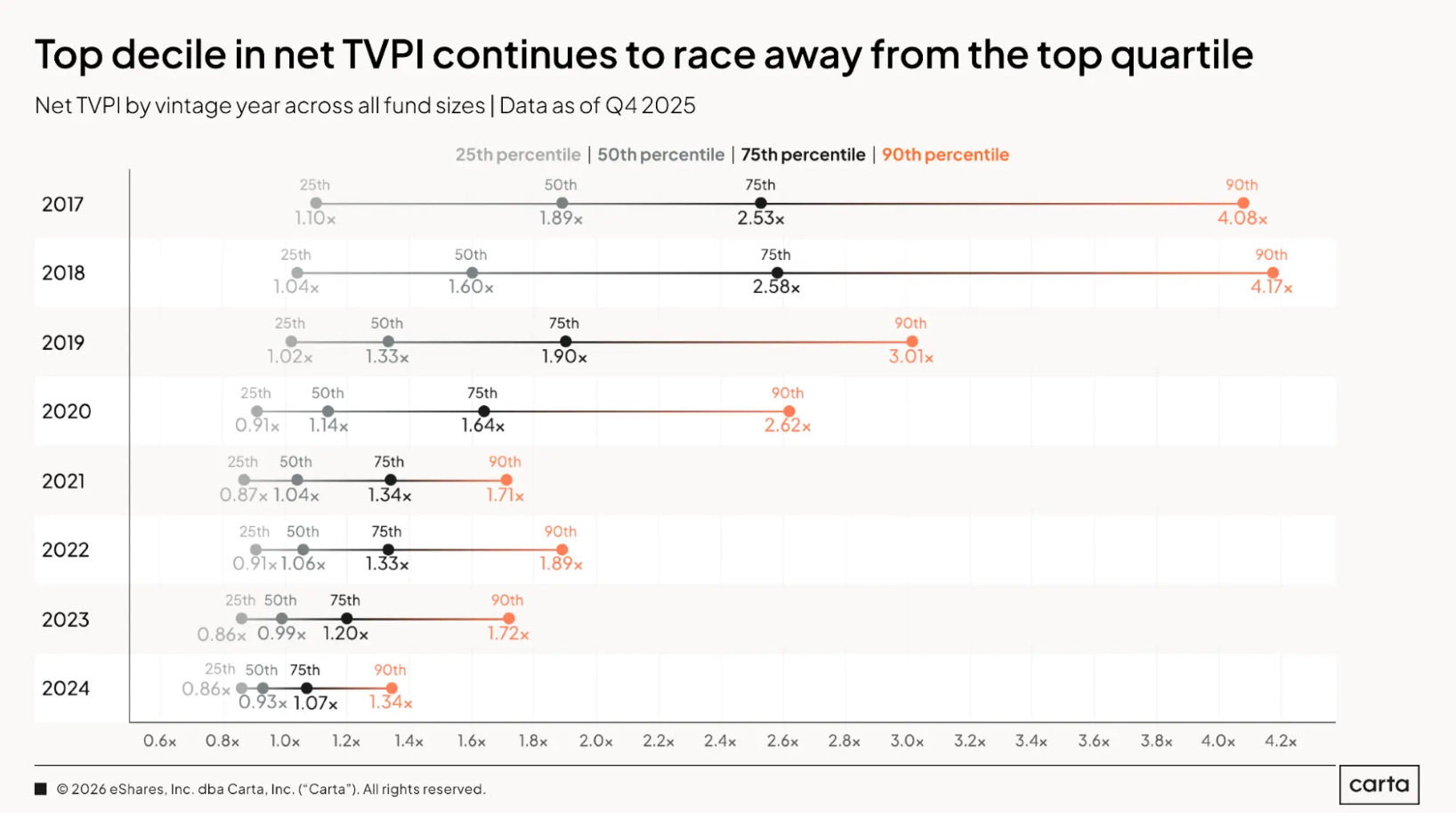
The gap between the top performing venture funds and everyone else is widening.
We’ve written about this trend extensively when it comes to the ability to raise mountains of capital. Now we’re seeing some of the recent larger top-tier funds enjoy some unusually quick markups.
That’s the major conclusion from Carta’s Q4 2025 VC Fund Performance report, based on reported data from nearly 3000 venture funds that use its fund management software.
Carta reports that funds in the 90th percentile of performance from 2017 and 2018 are showing TVPI that’s nearly double those in the 75th percentile. The best players are running away with it even compared to the good ones, with the 50th percentile funds left in the dust.
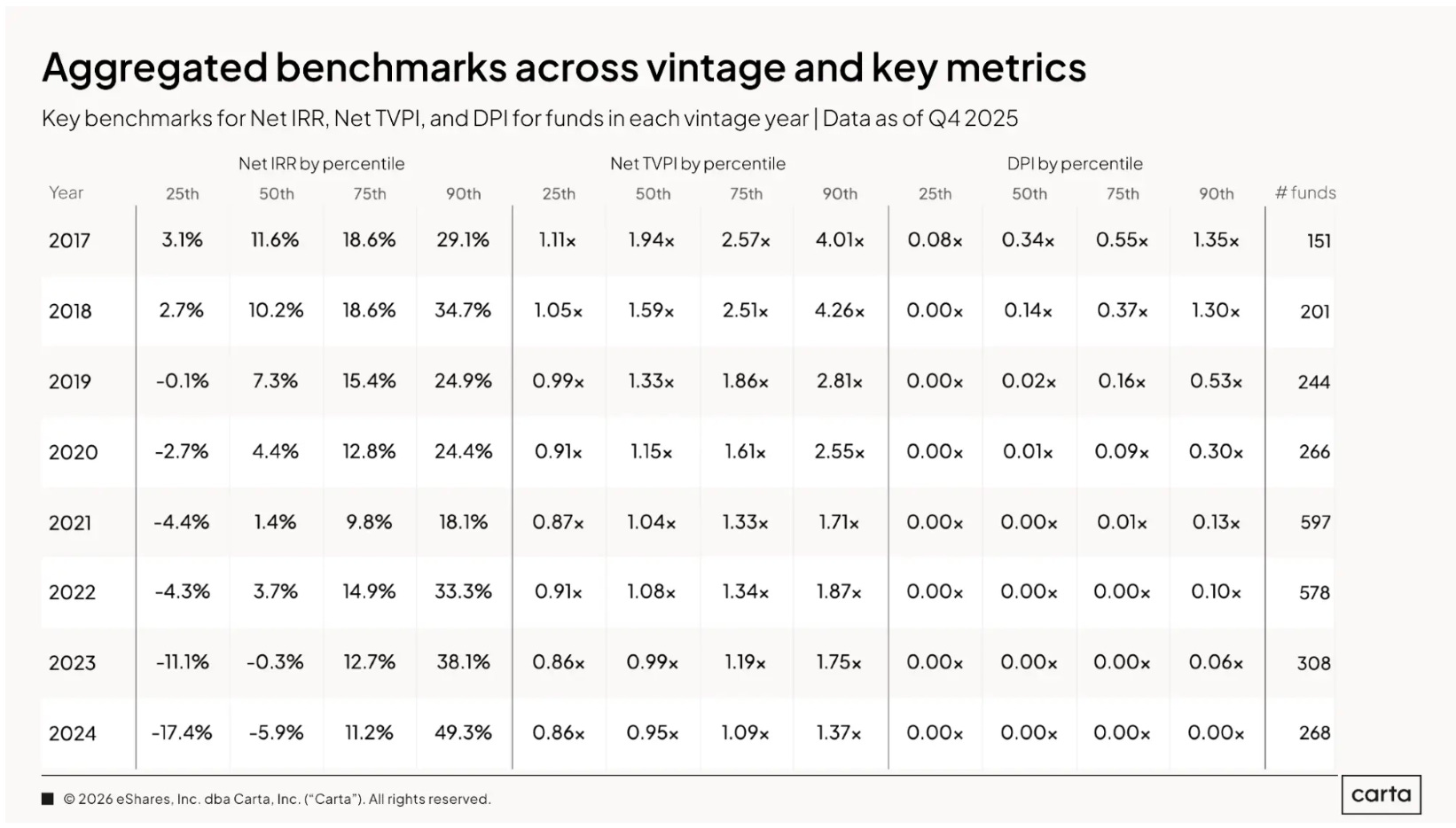
Carta’s IRR data broken down by size and year aligns with what we saw in our recent post on UTIMCO fund data: the top percentile of funds with $100 million or more have seen IRR shoot up in recent years. Funds of this size from 2018 are seeing IRR hit 54.7%, while funds from just last year have reached 77% IRR.