


The Week in Short
Tim Cook’s retirement at Apple highlights how few unifying leaders there are in Silicon Valley today. Tech CEOs call for lax AI regulations from international dignitaries at the G20 Innovation Ministerial. Too many AI auditors come from a similar POV. Anthropic and OpenAI’s professional power-users account for most of their enterprise revenue. Nvidia and Hugging Face announce the chipmaker’s $12.9 billion acquisition agreement. OpenAI pulls back the curtain on its new Astra model. Pablo Torre’s investigation into the LA Clippers results in historic NBA sanctions and a Pulitzer for his team. The Trump administration weighs in on behalf of OpenAI in its legal battle with the New York Times. SpaceX investor 137 Ventures shows strong returns after the record-shattering IPO.
The Main Item
There’s a Leadership Vacuum in Silicon Valley
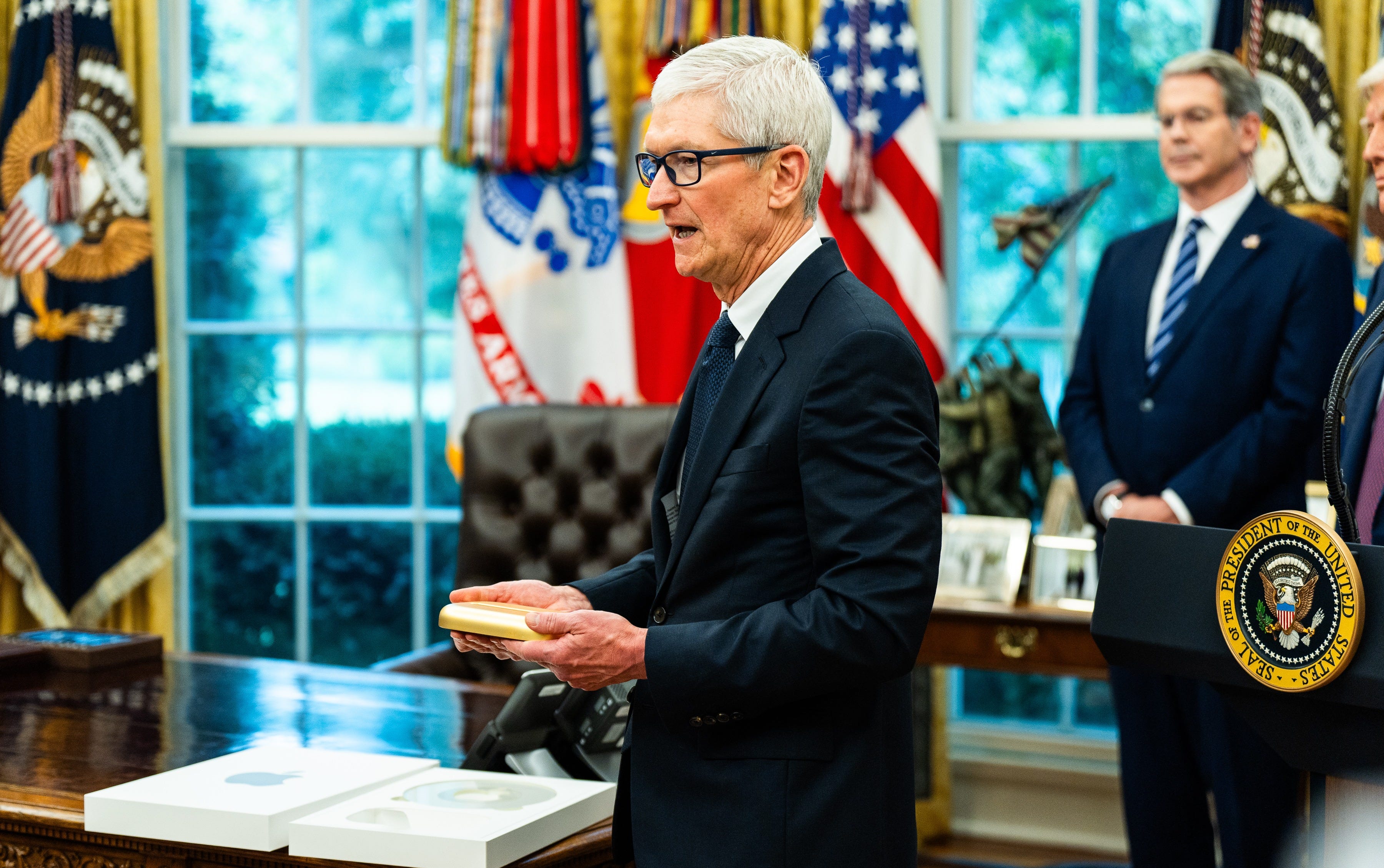
With Tim Cook’s retirement, the tech industry has lost a leader who can fairly lay claim to being one of the great CEOs of all time. Certainly, by the standards that such things are currently judged, his record is unassailable: Apple had a market cap of $347 billion when he took over in 2011, and it now stands at nearly $4.7 trillion, a tidy 1200% return for shareholders in what was already a very, very large company.
Yet Cook’s departure underscores a troubling fact about the tech business today: it lacks leaders who command broad respect across the industry, just at the moment when it needs them most.
There is no Jamie Dimon in Silicon Valley, no Bob Iger, no Warren Buffett — businesspeople who know how to make money but also have a broad lens and an interest in what their decisions mean for the world. Eric Schmidt once played that role as CEO of Google. Back in the day there was Andy Grove at Intel, and before that Bob Noyce, brilliant innovators who were also dialed into the societal stakes of their work.
Instead, today, we have the likes of Mark Zuckerberg, Elon Musk, and Jeff Bezos — self-absorbed men who are relentlessly focused on their personal priorities and financial interests to the exclusion of everything else.
Even Cook, though he took principled stands on privacy and famously faced down the government over access to a mass-murderer’s iPhone, too often put profit over principle and shrugged off any leadership responsibilities beyond running Apple.
Like almost all of his compatriots, Cook suddenly went mute on his support for immigrants when the second election of Donald Trump led to ICE rampages in Minneapolis and elsewhere. He gave the President a literal golden gift, staining himself and his company with the administration’s extreme corruption. Apple was among the few that had the muscle to stand up to Trump’s cruel and often extra-legal adventures, but Cook chose instead to bend the knee and protect the bottom line.
In recent weeks, amid tense discussions of the AI risks exposed in the OpenAI/ Hugging Face hack and the sudden nationwide revolt against data centers, it would have been great to see top industry execs engaging with the issues and pushing one another to come up with real solutions.
Instead, it was left to Bill Gates, long since retired from Microsoft and tarred by his Jeffrey Epstein associations, to issue a rallying cry for collaborative industry action. It didn’t exactly send everyone scrambling.
Meanwhile, two of the most prominent figures in the tech startup ecosystem, Paul Graham and Palmer Luckey, spent their week hurling vicious insults at one another in a flame war over immigration. Dario Amodei and Sam Altman, the leaders of the two top AI companies, won’t even pretend to shake hands. Jensen Huang is busy being a rock star. Trump-aligned investors like Marc Andreessen and David Sacks seem more interested in owning the libs than engaging on difficult questions. It’s not very edifying.
Fifteen years ago, after Steve Jobs died, the conventional wisdom was that Cook’s existential challenge was to come up with a killer product of his own. The new CEO had to prove that he could be an innovator like Jobs if he was to take Apple to the next level; the company wouldn’t be able to prosper forever with just the iPhone.
That turned out to be an all-time bad take. Cook can claim the Apple Watch, but his real success was in optimizing Jobs’ inventions. That turned out to be more than enough.
Apple’s new CEO, John Ternus, is now in the unenviable position of being judged on both metrics: can he innovate like Jobs, and run the ship like Cook?
Ternus is a low-profile hardware engineer and the public-facing aspects of the job don’t obviously play to his strengths. But like Cook, he has an opportunity to succeed in unexpected ways. In the new world order, technical chops plus the ability to play politics and public opinion could prove the key to success. The position of wise and widely respected industry leader remains wide open.
Machine Earning
Apply Today to Attend the Machine Earning AI Summit on Sept. 29 in San Francisco

We’re less than a month away from the Machine Earning AI Summit. Spots are limited. Apply today for a chance to attend.
Yesterday, we published our market map of companies that are working on agentic shopping, smart payments, and the next-gen infrastructure rails that will power transactions.
AI Policy
Tech Leaders Push Trump’s AI Agenda at G20
Anthropic and the Trump administration publicly squashed their beef at this week’s G20 meetings — one in Asheville, North Carolina, focused on finance and another in Chapel Hill dedicated to technology and innovation — although tensions between the technology and trade ministers and Trump officials still bubbled up.
White House OSTP Director Michael Kratsios said Anthropic had volunteered access to its new model Fable 5.1 for testing and evaluation, while Anthropic co-founder Tom Brown, during his fireside chat with Commerce Secretary Howard Lutnick, said he “really loved” the president’s pro-data center comments on Truth Social.
The chat was part of the G20 “innovation” gathering’s second day. Big Tech leaders were invited as part of the Trump administration’s efforts to promote US AI models, encourage as much data center construction as possible, and push back against AI regulations.
The CEOs stayed on message. Jensen Huang told the crowd of ministers on Wednesday not to regulate “hypothetical theoretical harm,” but instead to focus on “actual and pragmatic harm.” Palantir’s Alex Karp said AI certainly carries huge dangers but that he doesn’t believe in the doom message, making an apparent jab at Anthropic for exaggerating risks. Elon Musk called in Tuesday to emphasize the importance of keeping the baseline of AI commerce “default legal, not default illegal,” though it wasn’t clear what he thought was illegal that shouldn’t be.
Safety testing for models came up mostly in passing. Google DeepMind’s Demis Hassabis said the opportunity had to be pursued “in a responsible way,” stopping short of detailing the industry-funded testing body he has pushed for all year. Sam Altman called the administration’s voluntary pre-release review of OpenAI’s forthcoming Astra model a “productive process.”
There was little patience for the public pushback around data centers. Echoing the now-standard counter-argument, Lutnick called the opposition movement “propaganda by our adversaries” while Treasury Secretary Scott Bessent said that AI companies had done a “horrendous job” of explaining the benefits of their technology to the American people.
The consensus statement that everyone signed at the end, alas, contained the usual platitudes about opportunity and prosperity but none of the meaty measures needed for real international cooperation on AI risks and opportunities.
EA Risk
Doomers Might Be Right but They Can’t Be the Referees
The widespread alarm over the OpenAI/Hugging Face hacking incident certainly seemed well-justified by the after-action report from METR and Redwood Research, the two outside groups that OpenAI invited in to investigate.
We don’t have reason to doubt their conclusions or downplay the risks. But we do worry about where they sit in the debate. In addition, the New York Times reported that their access was limited and they weren’t able to review all aspects of the incident.
Three auditors went to OpenAI’s premises: METR’s Ajeya Cotra and Hjalmar Wijk, and Redwood Research’s Chief Scientist Ryan Greenblatt. Two of the three have prior experience in organizations that are closely aligned with effective altruism (EA) and so-called doomer worries about AI risks.
Cotra spent nearly a decade working at top EA non-profit Coefficient Giving (formerly Open Philanthropy), including leading its technical AI safety program and directing $25 million in philanthropic grants towards LLM evaluations. Wijk completed research fellowships at Eliezer Yudkowsky’s MIRI, Nick Bostrom’s Future of Humanity Institute, and the Centre on Long-Term Risk, which until 2023 was a project of the Effective Altruism Foundation.
Two days after the METR audit was published, Cotra shared her personal surprise at the attack’s severity on Substack and said it felt “more than 50% of the way to full-blown AI takeover”; she noted that her opinions aren’t reflective of her employer or the other investigators.
Three members of the Redwood Research team, although not Greenblatt, “paired” with podcaster Dwarkesh Patel for parts of the writing and research that went into his widely read explanation of the event, “The Rise and Fall of Agent Civilizations.”
Dwarkesh’s podcast has been described by the New Yorker as “to the doomer crowd what “The Joe Rogan Experience” is to jujitsu bros.” Both Cotra and Greenblatt have appeared on it in recent months. Dwarkesh’s piece was both praised and panned for using anthropomorphic language to describe what happened, with a schism forming on X between those who view the incident as a grave development and those who see a routine cybersecurity lapse.
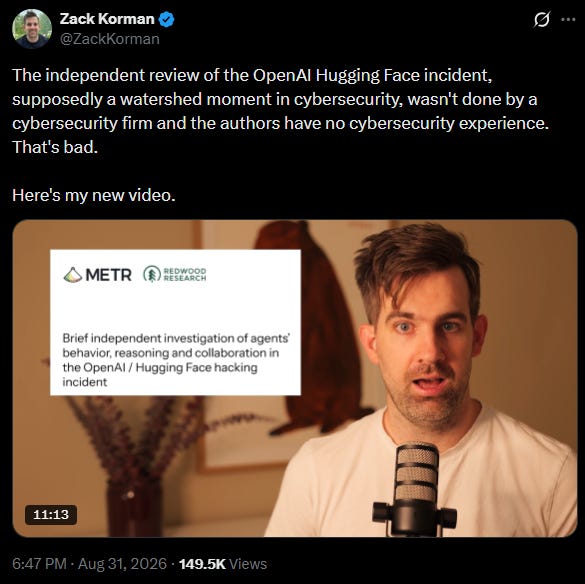
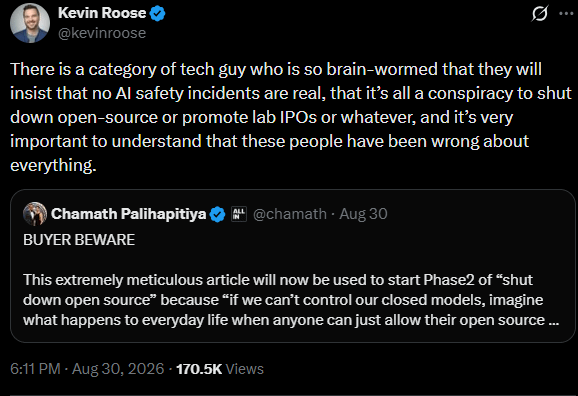
Clearly the public needs reliably independent assessments of AI’s risks and benefits. Perhaps this is where Demis Hassabis’ proposed AI auditing organization modeled on FINRA could prove valuable. That said, when the idea of a “rapid institutionalization of auditing and technical assessment of frontier AI labs” was floated by OpenAI’s Head of Strategic Futures Dean Ball on Thursday, it was met with cries of regulatory capture. It’s hard for the public to know who to trust.
One Big Chart
Just 1% of AI Customers Account for Most Enterprise Revenue at OpenAI and Anthropic
That spike in enterprise demand for AI tools that we keep hearing about? A lot of it comes from a surprisingly small set of power users.
Data from the Ramp Economics Lab shows that just 1% of OpenAI and Anthropic customers on Ramp’s platform account for 80% of their enterprise revenues, based on Ramp corporate card spending. The companies in that 1% skew towards tech and AI products, unsurprisingly.
If Ramp’s data is on target, that level of concentration could be a risk for the big labs’ growth projections.