


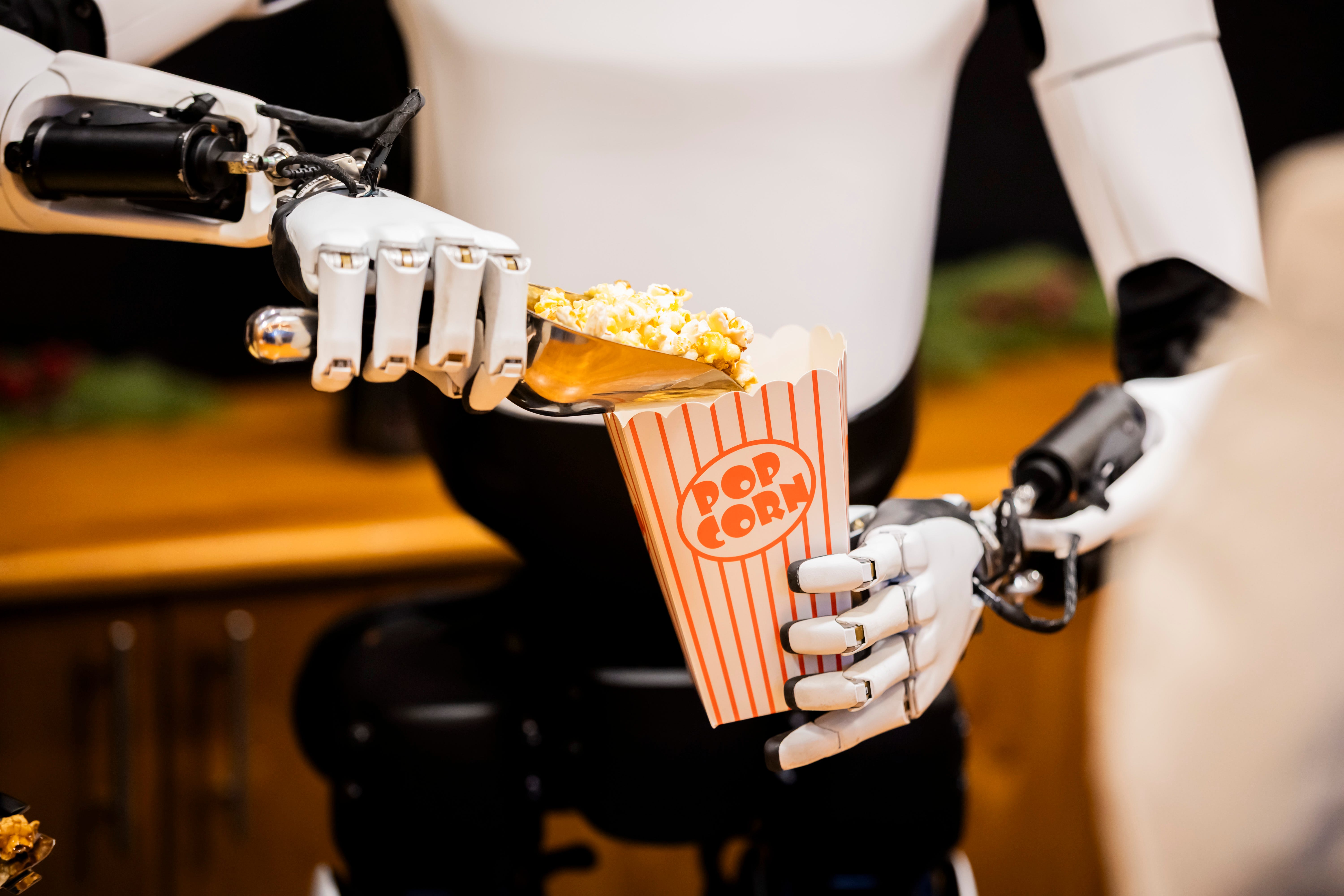
It’s a bold thing to say at a moment when the world’s richest man is offloading his struggling AI and social media company to surging SpaceX, but the craziest thing Elon Musk did in recent days may have been deciding to go all-in on Tesla’s Optimus robots.
Last week he announced he was sunsetting two Tesla models — the S and X — and repurposing the Fremont, Calif. factories that manufactured them to build humanoid robots instead.
The decision came a few weeks after Musk teased that Optimus would probably be coming out by the end of next year. It’s the kind of far-off date that essentially means “no time soon” and gives the company wiggle room to push it out further. Tesla has already delayed the projected release date for Optimus before.
As Elon goes, the industry follows. Investors have been pouring money into humanoid startups hoping to be — as one investor put it to me recently — alongside Musk in what they see as a guaranteed robotics revolution.
Last week we scooped that Foundation Future, which makes humanoids for manufacturing settings, was raising as much as $500 million at a greater than $3 billion valuation. Last month Skild AI, a Pittsburgh-based robotics company that’s building the software brains for robots, announced a $1.4 billion funding round, led by SoftBank with participation from Nvidia, Lightspeed, and Sequoia. It valued the company at $14 billion despite disclosing only $30 million in revenue.
But the current reality is that beyond the hype and exotic expectations, humanoids are nowhere near a public debut. The technology can’t deliver on what it promises — becoming robot butlers or factory hands — and the costs remain prohibitively high at $100,000 or more investors and executives say. That’s quite a price for a machine that can’t do what it’s supposed to do.
A Better Roomba?
That reality was crystallized for me after a meeting I had last week with Mehul Nariyawala, the president and co-founder of Matic Robots, which makes a robotic vacuum cleaner. The machine, which he demoed to me in the company’s Mountain View office, uses sensors to digitally map out a room and clean the floor without bumping into objects or people. The Matic vacuum goes for $1,245.
The company just announced a new $50 million fundraise, its Series A, from Sutter Hill Ventures, with Valor Equity Partners, Atreides Management, and others also participating. Previous investors include John and Patrick Collison, Garry Tan, and Adam D’Angelo. The company is valued at $650 million, according to a source familiar with the matter.
Making a better Roomba feels like a modest task, but Nariyawala argued that it’s where robot capabilities are at right now. This is still an infant technology.
“Our conclusion from day one was that even if you have a humanoid in your home, you still don’t want them to go where you’re not. You still don’t want them to get tangled up in wires. You still don’t want them to fall down the stairs or committing suicide by going down the indoor swimming pool,” Nariyawala said. “Just like zero to five-year-olds learn how to handle themselves and not fall down the stairs and not bump into things in the same exact way, we are teaching that perception right now.”
Matic has ambitious plans to use what they learn about perception and room navigation with autonomous vacuums and apply it to a wheel-based household assistant robot it calls a droid (think R2-D2 and not C-3PO). He showed me a video of it doing a simple organizing task. It was slow. Eventually, Matic hopes to reach the “Rosie the Robot” from The Jetsons iteration, but that’s years away.
Ajay Agrawal, a partner at Bain Capital, has been critical of the humanoid fixation. Though a big believer in the robotics category he says making a mechanical human is too complicated. “I’d be hard pressed to say you want a humanoid for most things. There’s a reason we ride bikes and cars and fly.” He’s backed Gather AI, which makes a software platform that analyzes data from warehouse drones for inventory management.
Not all robotics companies are betting on humanoids. Zipline, which does drone deliveries, recently announced a round valuing it at $7.6 billion — proof that focusing on specific, well-defined problems can still attract big money and achieve worthy goals.
By comparison, there’s 1X, which makes a humanoid called Neo and is backed by OpenAI, Tiger Global, and EQT Ventures. Testers were expecting it to ship its robots this month. The company recently told me they’re not shipping Neo in February but are “still on track to start delivering Neo to early access customers in 2026.”
In a demo clip 1X shows Neo organizing books on a bookshelf, pushing a vacuum and handing flowers to an elderly couple playing cards in a living room. Can Neo truly do these things? Unclear, though testers will be paying $500 a month for the opportunity to rent Neo or $20,000 to fully own the humanoid.
One VC who ponied up for a Neo robot texted me he was not surprised by the delay but still hopeful: “tbh if I get it by the summer, will still be monumental.”
Marketing Rules
There’s also Figure AI, which has raised over a billion from Microsoft, Nvidia, and OpenAI, for a humanoid for home and industrial settings. Despite its newly minted $39 billion valuation it also hasn’t been deployed at scale (and has had former employees griping about deceptive marketing claims to the Wall Street Journal). Agility Robotics’ humanoids for logistics and manufacturing uses are still under development after a decade.
Update: An Agility spokesman pointed out after publication that the company has sold "hundreds" of humanoids to customers over the past two years, which are in the field doing work.