


The Week in Short
Elon Musk, Marc Andreessen, and many other tech leaders are long on Trump and that’s not a good position. Rest of World falls victim to a more inward-looking era. Anthropic S-1 brings plenty of takes and a searing critique from Roger McNamee. Five races on Tuesday are especially interesting for Silicon Valley, starting with Texas. Thrive bought ADP, the venerable home-security business. Kalshi raised a billion. China’s AI bubble starts to deflate. Big tech earnings paint a mixed picture as Google and Amazon shares plummet while Microsoft jumps. Phone operator Jio celebrates India’s biggest-ever IPO. Revolut founder Nik Storonsky has choice words for VC.
The Main Item
Putting Half-a-Billion on Red Leaves Musk Open to Retribution
Odds are looking pretty good that 2026 will go down as the most epic year in the history of venture capital, with Anthropic, SpaceX, and a few others (Cerebras, OpenRouter, Hugging Face, Cursor) all delivering legacy-making returns for numerous investors.
It will also be remembered for unprecedented investment in a risky, volatile sector that venture capitalists and tech companies have historically avoided: electoral politics. Those bets are looking far less promising. On top of Trump’s disastrous policies and dismal approval ratings, opposition to AI has suddenly emerged as a major campaign issue and the GOP is on the wrong side of it.
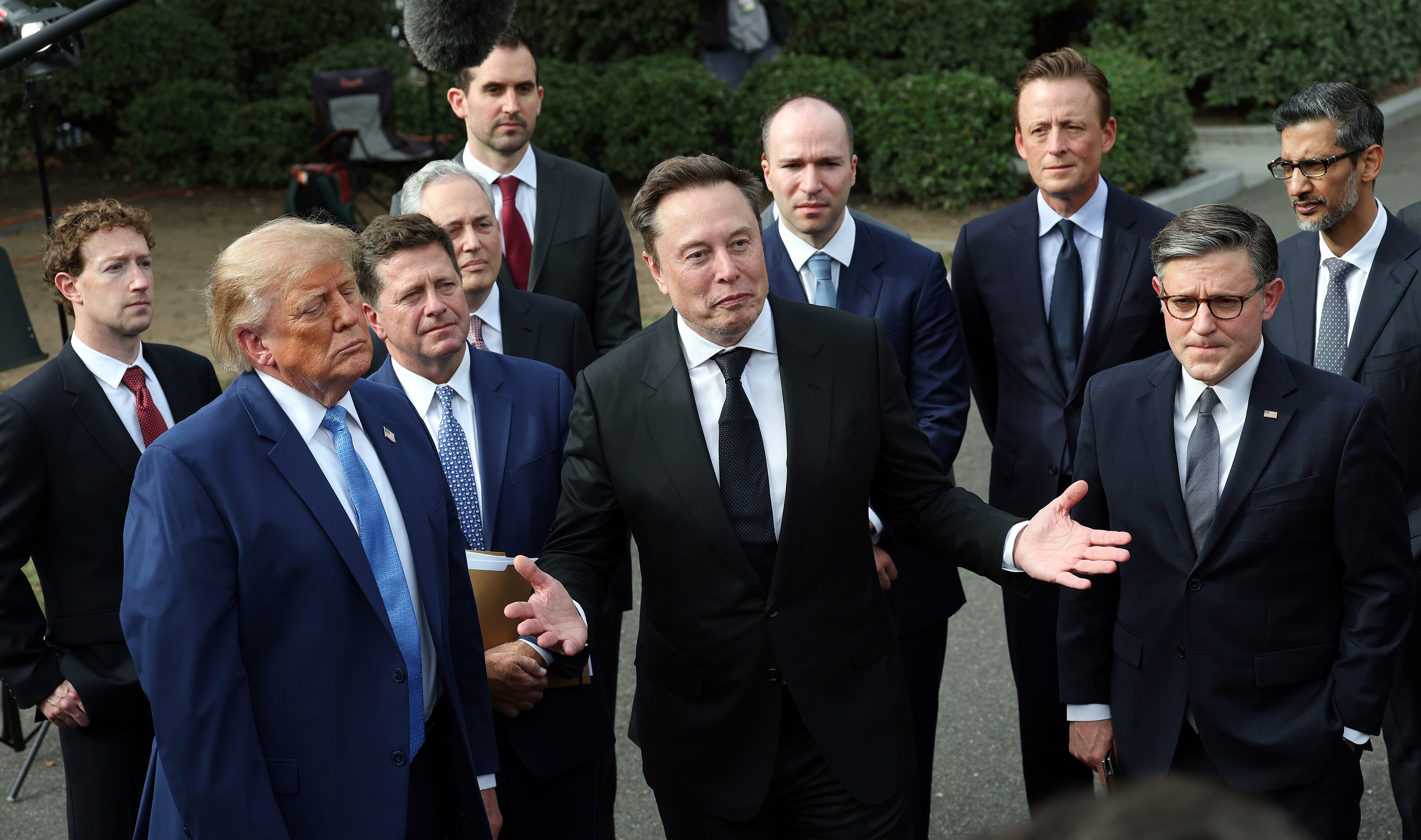
Elon Musk, of course, has made by far the biggest play, spending almost half-a-billion dollars supporting Republicans in the midterms thus far, according to the latest campaign finance reports. Almost $200 million of that has gone to Ken Paxton, the noxious Texas attorney general who’s in danger of becoming the first Republican to lose a statewide race there in decades.
Musk isn’t alone among tech figures now outpacing longtime Republican megadonors like Miriam Adelson and the Koch brothers. Ben Horowitz and Marc Andreessen have kicked in $92 million to GOP super PACs, Jeff Yass of Susquehanna $110 million, and Greg Brockman of OpenAI $50 million. (On the Democratic side, George Soros gave $102 million and Michael Bloomberg $84 million, with no other donors exceeding the $40 million mark.)
Then there are the other forms of donation: appearing at the White House and showering the President in gifts and praise, and kicking in for the infamous ballroom, as Jeff Bezos, Tim Cook, Jensen Huang, Mark Zuckerberg, and even Marc Benioff have all done.
It’s no mystery why business leaders typically try to play both sides of the aisle: politicians and party dominance can come and go, but corporations are forever. Going back to David Packard, who served as deputy secretary of defense under President Richard Nixon, tech executives have certainly had their partisan loyalties at times. It wasn’t that long ago that there was something of a revolving door between Silicon Valley and the Obama Administration.
Billionaires Rally Against Billionaire Tax
But there’s no precedent for Musk putting such a massive pile of chips on red, or for the overall scale of tech spending on politics. It goes well beyond the battle for Congress: in California, tech figures led by Sergey Brin are also investing huge sums to beat back a proposed one-time 5% wealth tax on billionaires. The campaign against it has spent an astonishing $330 million so far, with Brin contributing more than $100 million on his own and Silicon Valley heavyweights including Eric Schmidt, John Doerr, and Patrick Collison accounting for most of the rest.
If team blue wins the Senate, and especially if they win the Texas Senate race and/ or the governorship, Musk’s investment is likely to look very foolish. Democrats are already salivating about how they might take their revenge, floating ideas like new laws that apply only to people with a net worth of more than $500 billion. The nationalization of parts of SpaceX could even be on the table.
It’s still possible that Musk’s money will help prevent the worst for Republicans. It’s also possible that in the event of defeat, he’ll simply switch his massive underwriting to Democrats, many of whom would be sorely tempted to take the money rather than go to war with the world’s richest man. A16z likely made this sort of calculation, having shown a willingness to hedge its bets when Horowitz said he’d also donate to Kamala Harris shortly after the firm endorsed Trump.
Indeed, as Politico reports, tech firms are already scrambling to hire lawyers and lobbyists as they brace for inquiries from a Democratic House and possibly the Senate.
Musk appears to be in a race to merge Tesla and SpaceX and lock in as much federal money as he can while he still has a friend in the White House. That dynamic is in itself… unhealthy! It’s also a dangerous gamble for Musk and his backers. Investors who want to bet on politics would be better off sticking with Kalshi.


Deglobalization Watch
Waning Interest in Tech’s Global Impact Dooms Rest of World
The news this week that Sophie Schmidt’s Rest of World, which explores the global impact of technology, is likely to shut down doesn’t come as a huge surprise. Launched in 2020, it was clearly a difficult financial proposition from the start, an expensive exercise in high-quality journalism about important topics that lacked a well-defined target audience or monetization strategy. It was a non-profit, to be sure, and Schmidt, the daughter of the former Google chairman, personally committed up to $60 million over a decade for what she called her “life’s project.” But philanthropy is rarely enough by itself.
We don’t have any reason to believe that Schmidt lost interest or didn’t do everything she could — a common hazard when wealthy people underwrite journalism — but cratering traffic and lack of a viable growth path will ultimately do in a non-profit just as they would a business.
Yet the expected demise of the publication (Schmidt said it will close in January absent a white knight) is about much more than AI’s impact on Google search and the ever-present challenges of new media business models. Rest of World debuted at a moment when the immense and lightning-fast changes that smartphones and social media were bringing to all corners of the planet had become an important part of the technology conversation.
Your Newcomer scribe was running global technology coverage for Reuters at the time, based in Singapore, and we went hard after stories about, say, how Facebook was transforming the Vietnamese economy, or stoking ethnic violence in Myanmar, or employing armies of Indian contractors. Rest of World’s highlights ranged from a deep-dive on China as the world’s shopping cart to long-term beat coverage of the plight of gig workers around the globe. They were a very welcome addition to the mix.
Now, though, in the era of deglobalization and Trumpian hostility to journalism, idealistic non-profits, and anything that smacks of “rest of world,” there just isn’t the same interest in those kinds of stories. There’s no point in doing expensive, worthy reporting that isn’t able to build a meaningful audience. Yet it’s hard not to be a bit sad that a richly funded international reporting operation like Rest of World, doing ambitious work on major global stories, just couldn’t find a way.
Chatter
Six Takes on Anthropic’s IPO
The Anthropic S-1 has been a god-send for tech and finance take-havers this week. Here are a few thoughtful or amusing ones we’ve seen so far.
NYU Stern professor Aswath Damodaran broke through on Wednesday with his case that Anthropic should be valued at $1.475 trillion, not in its $1.5- $2 trillion current standing.

Roger McNamee calls the IPO “a very dangerous thing for investors,” and regards the S-1 as “speculative fiction.” (See his full anti-AI screed here.)
 Squawk on the Street@SquawkStreet"In many use cases, the cost of the infrastructure of AI is still rising – those are not formulas for high returns for equity investors from here." Elevation Partners Co-Founder @Moonalice calls Anthropic's IPO an opportunity to cash out:cnbc.comAnthropic's IPO is a 'very dangerous thing for investors': Elevation Partners' Roger McNamee4:18 PM · Oct 27, 2026 · 3.66K Views4 Replies · 3 Reposts · 8 Likes
Ed Elson did a breakdown on which risks on the S-1 actually matter.



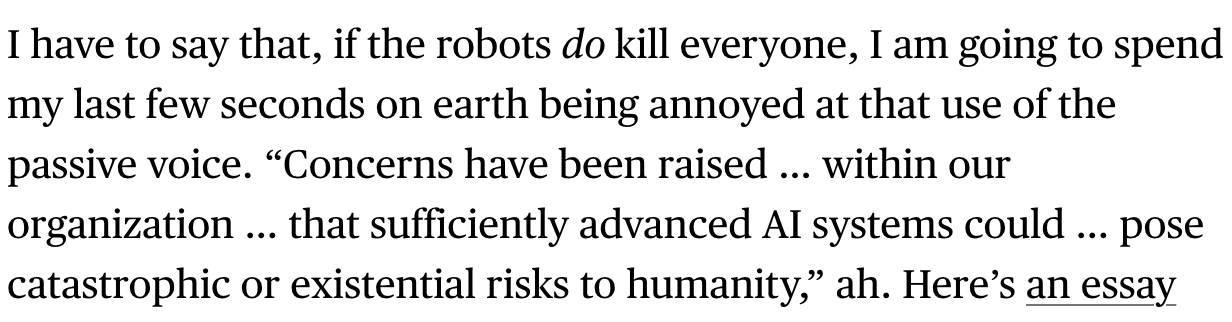
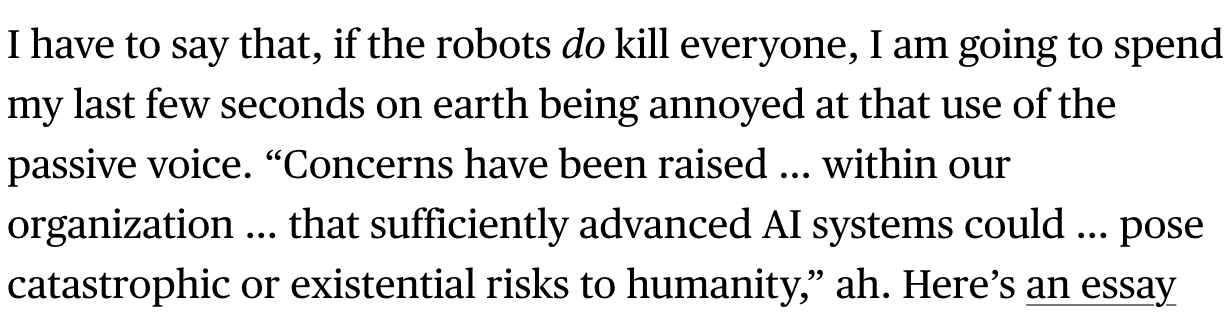
Matt Levine delivered a sharp observation on the S-1's blend of AI doomerism and banker verbiage.
A note about the unprecedented nature of the potential wealth creation from a semi-anonymous poster.

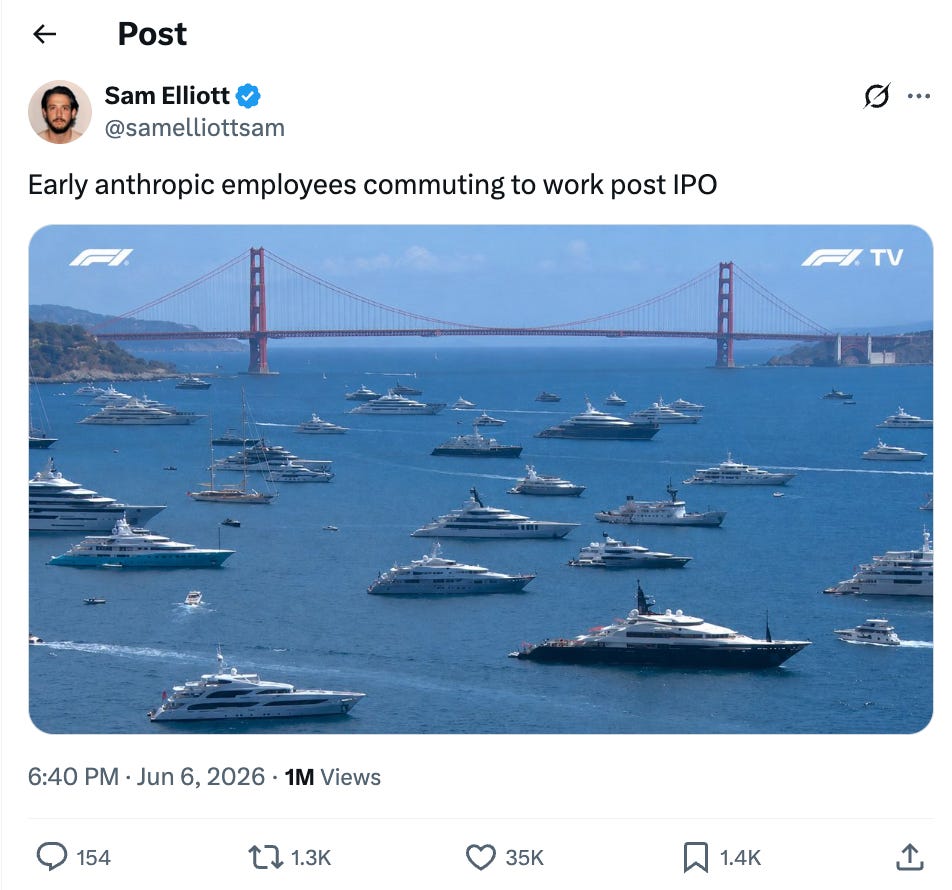
And finally, a good meme:
Midterm Elections
Five Races with High Stakes for Tech
Texas Governor and Senate Races: With Governor Greg Abbott fending off a strong challenge from Gina Hinojosa and Ken Paxton in a dead heat with James Talarico, Elon Musk has swooped in with large amounts of last-minute spending. He’s put in an additional $5 million into the Governor’s race and nearly $168 million into the Senate race. Talarico and Hinojosa have both leaned into anti-billionaire rhetoric while Abbott plays defense on data centers.
California Billionaire Tax: The one-time 5% wealth tax on California’s billionaires to cover healthcare deficits has led around 70 current and former billionaire residents to spend $612 million in statewide races so far, per Politico, with around half of that in direct opposition to the initiative. The latest polls show support for the tax falling but the outcome is far from predictable.
Washington State Millionaire Tax Repeal: The legislature passed a 9.9% tax on household income exceeding $1 million per year this March, scheduled to go into effect in 2028. Opponents rallied to get Ballot Initiative 645, which would repeal the tax, in front of voters.
Ohio Senate Race: The crypto industry PAC Fairshake has poured over $55 million into the race in an effort for defeat Democratic challenger and former Senator Sherrod Brown, a longtime critic of the industry. Brown has been attacking his opponent, incumbent Senator Jon Husted, for being too supportive of data center construction.
Florida Governor’s Race: Representative Byron Donalds has been running possibly the most pro-data center campaign in the country as Americans broadly sour on their construction. His opponent, David Jolly, has branded him “Data Center Donalds.”
Seven Notable Deals
Kalshi, Thrive Holdings + ADT, Re:Build, Bedrock Robotics, Serval, General Compute, Disruptive
Prediction markets platform Kalshi reaches a $40 billion valuation. Plus, hardware startups have VCs shelling out for manufacturing, robotics, and compute.