


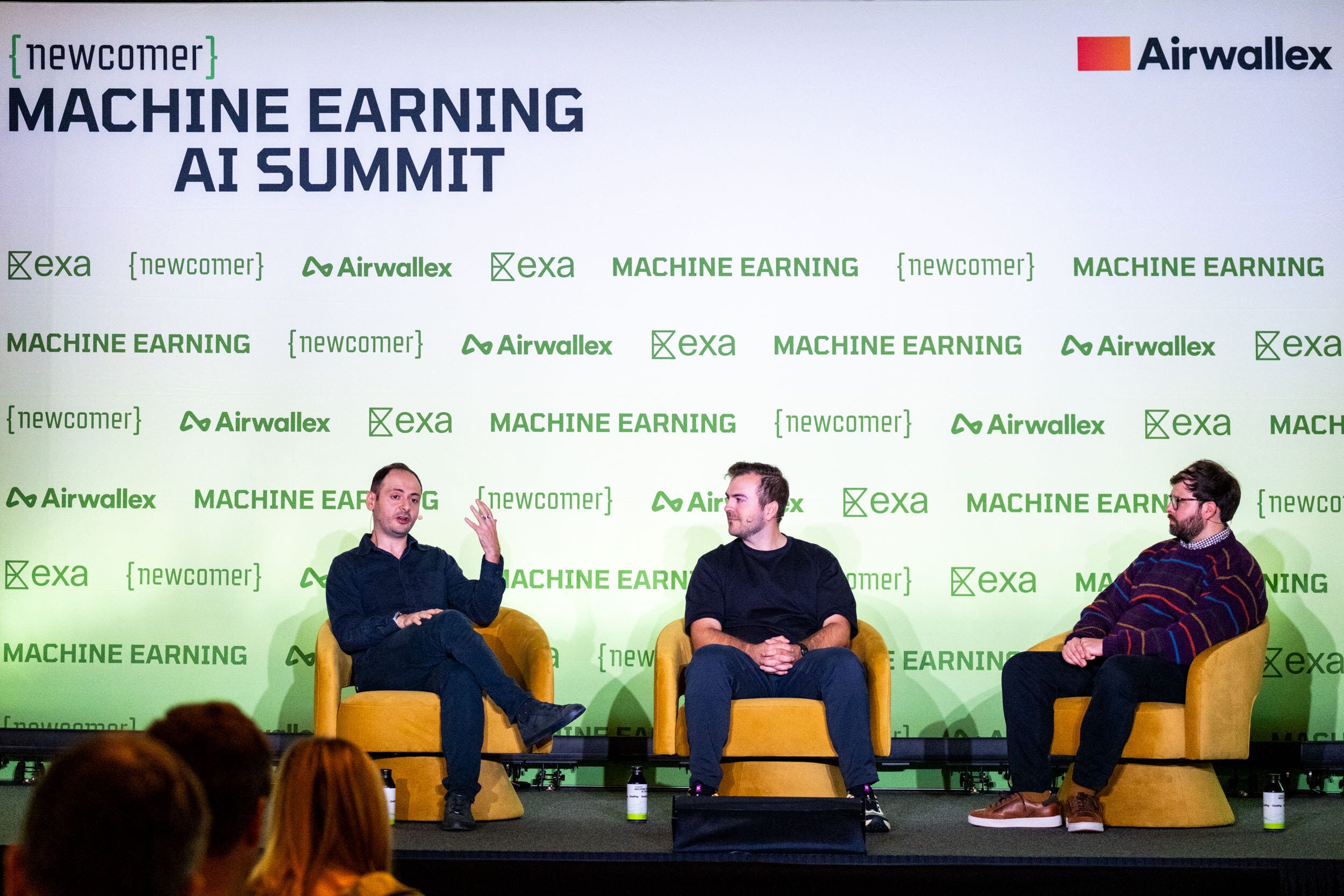
We were fascinated to hear from the founders and investors building a new generation of companies in finance and commerce at our Machine Earning AI Summit in San Francisco last week.
Industry leaders including Jean-Denis Greze, the co-founder of Town and former CTO of Plaid; Katie Haun, the founder of Haun Ventures; Ryan King, the co-founder of Chime; and Ilan Zerbib, the co-founder of Sapiom, offered insights on where fintech is going in the AI era.
We’re sharing all nine on-stage conversations here in the newsletter and on our Newcomer AI Summits YouTube channel.
Big thanks to our sponsors Airwallex, Exa, Nebius, Lead Bank, and OnePay.
Jean-Denis Greze (Town)
Town co-founder and CEO Jean-Denis Greze told the crowd that he isn’t losing sleep over agents going rogue. He said humans will approve purchases at first, and the mistakes that slip through will get budgeted in, as with credit card fraud today.
He does view personal AI agents as a business tool, calling the consumer business “a market to zero” because regular people rarely pay for software.
Jackie Reses (Lead Bank)
Lead Bank CEO Jackie Reses had spent weeks in Washington, D.C., ahead of the summit, meeting with stakeholders about her new 30-page proposal for how the financial system should treat AI agents.
“If a model hallucinates, whose responsibility is that?” she asked. She also reminded the room how early it still is for agentic commerce.
Katie Haun (Haun Ventures)
Katie Haun began the day emphasizing how much the systems for smart payments have improved in just a few short years.
She compared the AI industry’s rapid growth and regulatory hurdles to what crypto companies went through. She noted that, as with crypto startups, AI companies seem unprepared for the public backlash they are now facing.
Anish Acharya (Andreessen Horowitz)
Andreessen Horowitz general partner Anish Acharya named the three areas he thinks will produce the next wave of unicorns: industry-specific personal agents, coding agents for small businesses, and AI for entertainment. “The horizontal agents are going to hire the vertical agents to do things. Not enough people are building there,” he said.
Omer Ismail (OnePay)
Omer Ismail, the co-founder and CEO of the consumer fintech OnePay, made the case that “walled gardens” on the internet will soon become a thing of the past, thanks to AI agents. Safety will come in the form of new kinds of limits or guardrails on the agents — OnePay has “spend pockets” that cap what an agent can do.
Ilan Zerbib (Sapiom) & Paul Klein IV (Browserbase)
Sapiom co-founder and CEO Ilan Zerbib and Browserbase co-founder and CEO Paul Klein IV made the case that the big opportunity in agentic commerce is agents that buy on behalf of businesses. Browserbase gives agents the tools to navigate websites, and Sapiom builds the rails that let them pay. Klein said agents will take over back-office work like accounts payable and accounts receivable. One Browserbase customer’s agent recently made a $300,000 purchase on a credit card, Klein said.
Pranav Sood (Airwallex) & Mike Taylor (Gusto)
Gusto CFO Mike Taylor and Airwallex CFO Pranav Sood explained how they have integrated AI tools at their companies, with Taylor saying Claude has “completely changed” his role as a CFO. He now reviews Claude’s summaries and reports instead of raw spreadsheets.
Gusto, he said, has passed $1 billion in trailing revenue and has been profitable for about three years. Sood said Airwallex now operates in more than 20 countries and has reached $1.4 billion in annualized revenue; he also pushed back on recent scrutiny of Airwallex’s China ties.
Max Rhodes (Faire)
Faire co-founder and CEO Max Rhodes told the crowd at the Machine Earning AI Summit that he isn’t worried about AI agents cutting marketplaces out of the loop.
He argued that what LLMs do well, like back-and-forth conversation and personalization, is exactly what marketplaces can build into their own shopping experiences.
Ryan King (Chime)
Chime co-founder Ryan King said AI agents will make switching banks much easier, which is a big threat to how traditional banks have kept customers.
Still, he said regular people aren’t ready to let AI run their money. Chime’s AI assistant Jade helps customers track their budgets and spending habits but stops short of making direct purchases for them just yet.